
Have you ever tried to come up with something new— an idea, design, or opportunity— to feel like you keep drawing blanks? Like your brain simply isn’t doing what it needs to do? No matter how hard you try, you just feel stuck? It’s not just you. Most of us have faced this situation once or twice. Here are some ideation techniques to help spark new ideas, or at the least, get some wheels turning so you can start making progress.
What is Ideation?
According to Interactive Design Foundation, ideation is at the heart of the design thinking process. There are literally hundreds of ideation techniques, such as brainstorming, brain-dumping, sketching, SCAMPER, and prototyping. Ideation involves taking ideas from your conscious and subconscious mind, to come up with the best solution. In other words, let your mind run wild! Let’s discuss a few techniques in detail.
Brainstorming
Brainstorming is probably the most common ideation technique. I can think back to my early school years and remember my teachers introducing this concept. In my eyes, I’ve always just thought of it as a fancy term for bouncing ideas around (by yourself or with others), to come up with a solution. During a brainstorm, you should be able to share ideas without fear of judgement.
Sketching
Sketching is a great way to bring ideas to life. Visuals sometimes help come up with new ideas a bit better than words do. Your sketches don’t have to be pretty, or well-thought out. It’s actually better if they’re messier and rough, as it leaves room for further development and improvement. Sketches are also great for sharing ideas with others.
Analogies
Using analogies to spark new ideas is exactly what it sounds like. The idea is to come up with similar situations or concepts, and build off of ideas that pop up. To me, using analogies sounded a bit weird and like it could be considered copying, but some designers believe that “all design is re-design.”
Ideation on Nike Training Club App
I wanted to see the above techniques in action, and decided to use them to come up with new ideas for a few different workout apps. I analyzed and compared three different workout apps and created two POV statements for each, after I collected enough data on user experiences. Then, I brainstormed, sketched, and analyzed each POV statement to try to come up with an idea to solve each statement.
The Nike Training app for example, had some issues with users feeling like it wasn’t beginner friendly. Users also wanted a way to track their previous workouts in a calendar form to stay organized and even plan future workouts.
POV Statement: Users who like to plan their workouts need a calendar feature to view their history and future workouts because there’s no way to see what they’ve completed, or the ability to track progress.
And here were my 3 different ideation techniques in action:
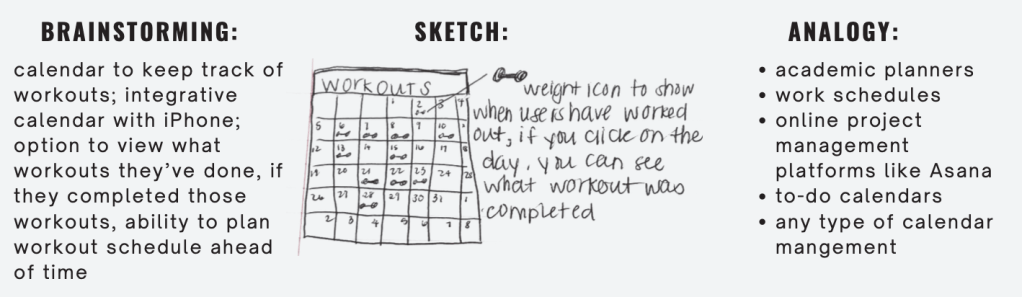
Notice how they differ? And how each technique comes up with different ideas? Off of one POV statement, I was able to build 5+ new ideas using just three techniques.
Try some of these new techniques if you’re feeling stuck, and I can almost guarantee that you’ll come up with something new. If you’d like to look more into my presentation on ideation techniques on my POV statements from last week, see below.
 Mia Krysa
Leave a comment