Category: ICM501

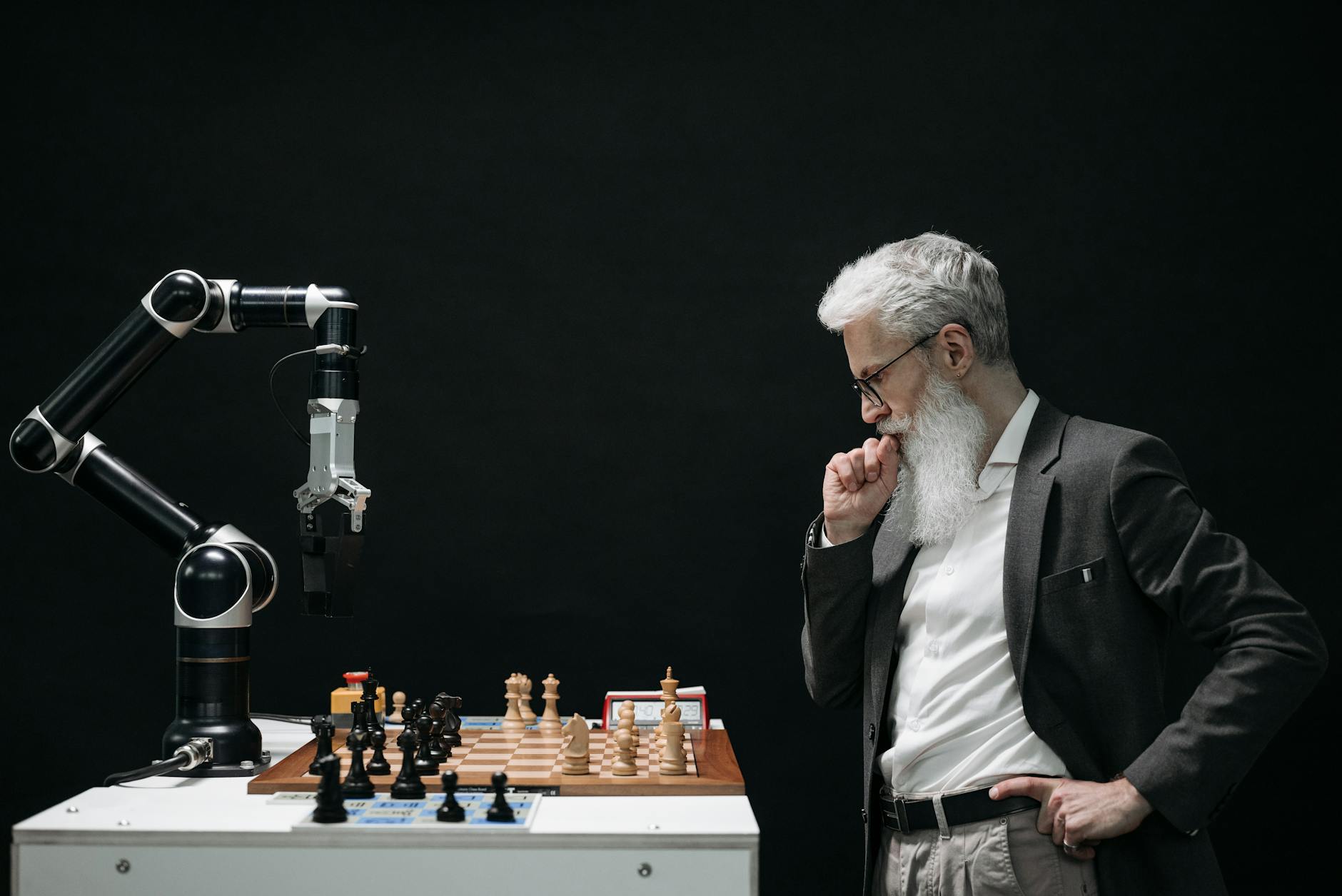
  • The Double-Edged Sword of Advanced Technology

    Photo by Pavel Danilyuk on Pexels.com

    Even though we’ve witnessed some of technology’s amazing benefits in today’s society, it often comes at a price.

    Tech is so much smarter than we are. The Center of Humane Technology explained it perfectly: Technology is extremely profitable, so it often develops faster than our ability to regulate it or understand its long-term effects.” Isn’t that crazy? Our brains can’t even comprehend information at the same rate as the technology being used today.

    Over these last few weeks, I’ve done a lot of thinking about tech, society, and how it’s changed how we behave. And right now, we only know its short-term effects, as the more advanced technology hasn’t come about until recent years. The rise of artificial intelligence is something that I, personally, have troubling comprehending.

    AI can do everything that humans can — but faster, and maybe in some situations, better. It can create images, and stories, gather information, answer questions, and more. There seems to be no limit to what it can do.

    Because technology is becoming so advanced, “it means we are rapidly disseminating technology with dangerous, exponentially advancing applications.” For example, the genetically modified babies. Let me explain.

    I didn’t even know this was an actual thing until I read this journal. He Jiankui (a scientist) and his team, used CRISPR technology to disable the CCR5 gene in two babies, which enables HIV infection. While I think his intentions were fair, it’s up for debate on whether this practice is ethical. The babies couldn’t consent in embryo, and we don’t know the long-term effects of disabling this gene. What if it causes other problems in different areas? What’s even crazier to me is that “CRISPR-Cas9 has made it possible to add, delete or replace genes, thereby opening the door to new types of genetic interventions.” Our technology has become so advanced to the point where we can change, edit, or delete genes. Whoever thought this would be possible?

    It’s overwhelming to think about the types of advancements we’ve had in technology lately. I can’t imagine a world where we have thousands upon thousands of genetically modified babies walking the planet. On the bright side, technology is so advanced that as a society, we can learn to use it for good. He Jiankui ended up serving 3 years in jail for performing “illegal medical practices,” but so far, the two babies are still healthy. Do you think that’s a fair punishment? Or that genes should be allowed to be modified? Do the benefits of technology outweigh the risks? I’m not so sure.

  • The Struggle to Focus in a Distracted World

    As I’ve continued reading Stolen Focus, I’ve begun to think more about ADHD, anxiety, stress, and the internet. Quite a handful, I know. Hari, the author of Stolen Focus, talked about an interview he’d had with Dr. Nadine Burke Harris. Dr. Harris explained how so many children and people are struggling to focus because their brains are focusing on surviving. Not only are we being overstimulated by things like social media and the news, but for some people, traumatic events cause them to constantly be on the lookout for the next shoe to drop.

    One heartbreaking story Dr. Harris told was about a boy named Robert who had been abused by his mother’s boyfriend. This happened around age 10, which is when his attention problems started happening. Think about the stress that this causes a child, and then picture that child trying to learn long division in school. Robert’s brain was using all of its energy to detect danger — his mother’s boyfriend — instead of learning new things. It wasn’t his fault he couldn’t pay attention.

    Robert was prescribed medication to help him focus in school, but his problems at home were being ignored. Why, as a society, are we ignoring things like this? Why are we ignoring the problems that are happening at home? The real-life issues? It seems like everything now is covered up with medicine or by ignorance.

    As a society, we’re given antidepressants instead of meditation and therapy. Drinking coffee instead of sleeping more. Watching TikTok when we could be outside. Not speaking to each other during meals. All of this comes back to the problem that I wrote about in my first blog post — is this really the true human experience? I don’t think it is.

    I’ve been traveling a lot these past few weeks. I was in Cleveland last weekend and am in Atlanta writing this post. And I notice the same behavior everywhere. As I look around the airport, everyone was on their phones. On the plane, there are TVs behind every seat. What happened to resting, sitting, and talking to each other? It sometimes feels impossible to escape media and just take a break when it’s all around you, all the time. I’m slowly learning that a slow, simple life seems to be the healthiest way to live. The challenge is, how do we live this way when society doesn’t let us? As a population, we are so used to being inundated with information that it’s hard to catch a break.

    I don’t know how we change society as a whole. But, the best thing we can do, is change our behavior for ourselves and those close to us. If enough people realize the true meaning of human connection and life itself, we might be on our way to healing.

  • Maximize Productivity with Asana: A Personal Review

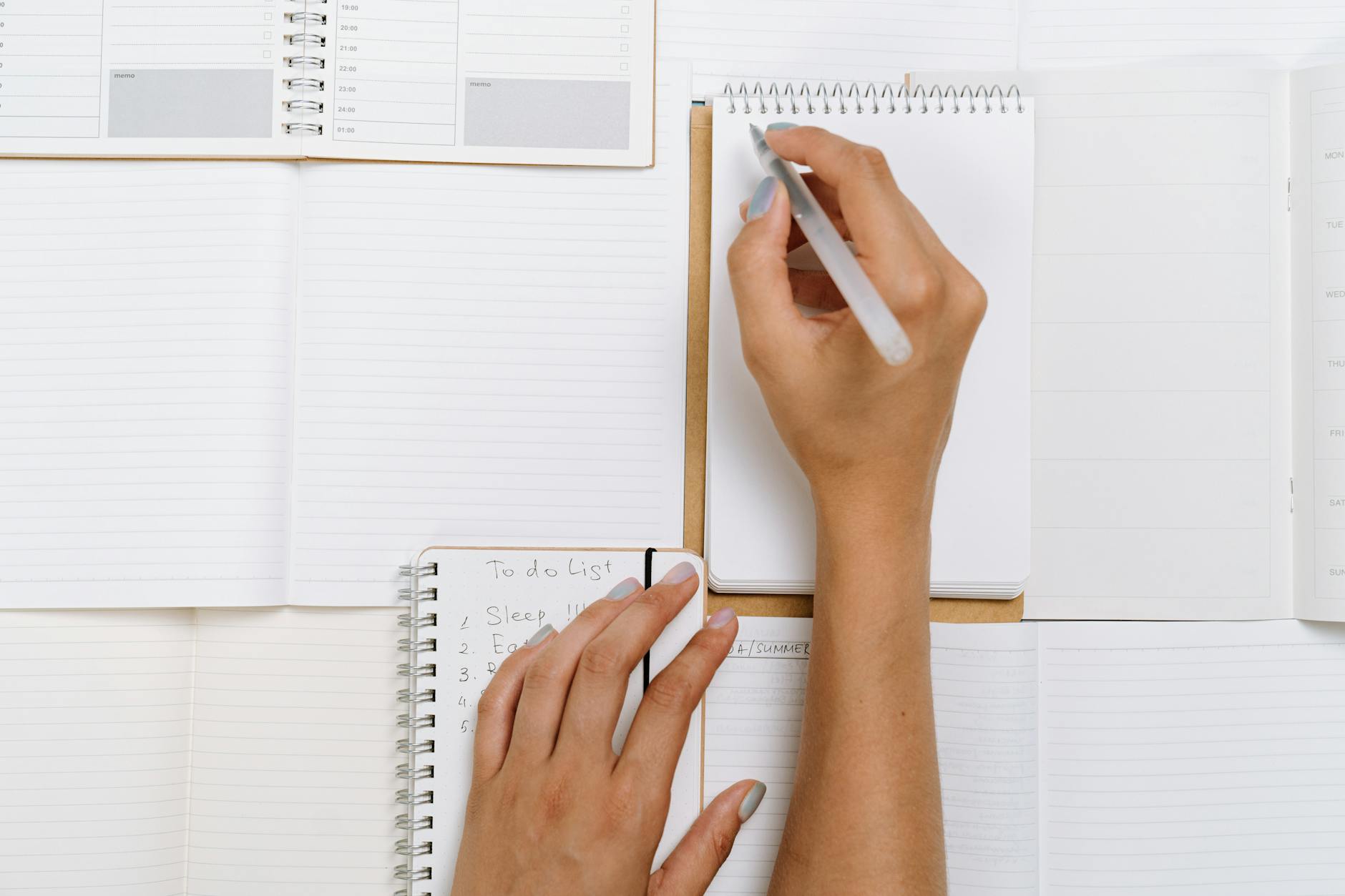
    I love lists. Grocery lists. To-do lists. Packing lists. Affirmation lists. Homework lists.

    I’ve used an agenda for school since fourth grade and I don’t think I could have gotten through my middle and high school years without one. To this day, I appreciate my teachers who would require us to write everything in our agenda as part of the homework assignment. For me, it never felt like work. There’s something about seeing everything taken out of your brain and written on a sheet of paper that makes it seem more accomplishable. At the end of the day when it came time to fill my backpack with books, I’d know exactly what I’d be taking home and what could be saved for later. And the best feeling is when you get to cross something off your list of scribbles (and never think of it again!).

    This week, I decided to use an online version of a to-do list/task management system called Asana. I’ve had experience using Asana in previous internships and loved it. I enjoy how you can organize everything. It reminds me a bit of Notion, which is another website you can use for organization and to-do lists. Asana, however, feels much more work- and project-related.

    I decided to set up my Asana so that it’s strictly project-focused and separated my schoolwork and business into different folders. I run a small business on Etsy and create digital artwork. It’s something I genuinely enjoy doing because it allows me to be as creative as I please. This week, I had a few custom pieces to create for customers. I used Asana to input each order, the steps I had to take to complete the orders, and the days I needed them completed by. For my custom pieces, I allow for a 3-5 day turn-around time. The due date feature on Asana is great for this!

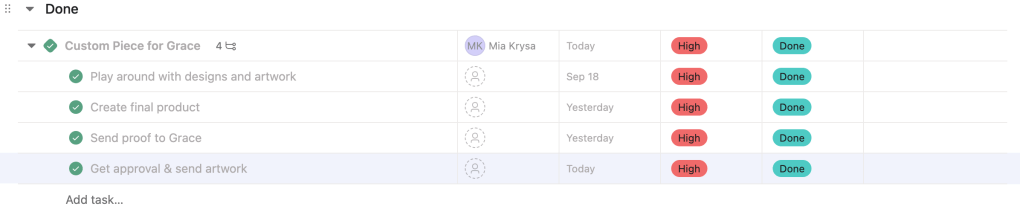
    My favorite overview is the list overview. I love the fact that you can also create subtasks within each task, so you don’t have an extremely long to-do list that instantly creates anxiety. You can hide the subtasks and cross them off as you complete them. Here’s an example of what a list looked like for one of my to-dos:

    If you don’t like the list overview, you can choose to switch it to a board view, timeline view, and dashboard view, among many others.

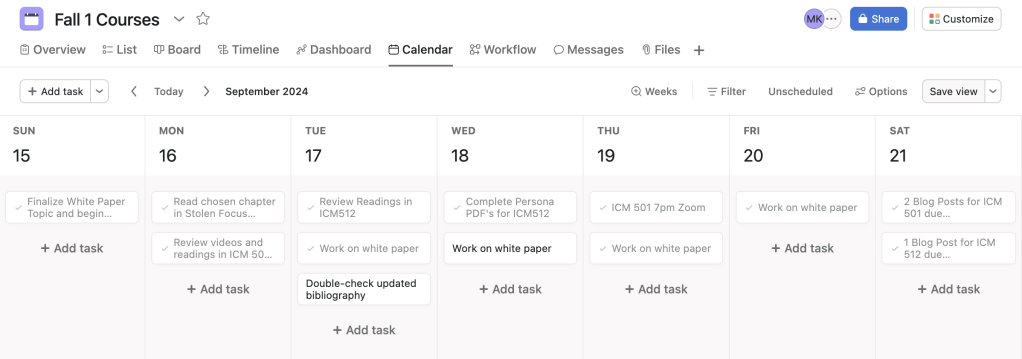
    As far as course organization, I created a new folder specifically for the white paper which is going to take a lot of time and focus. Then, I created a separate project folder just for this week but used the calendar option to organize it. Here’s what it ended up looking like:

    Overall, I can see myself using Asana week-to-week. The little unicorn explosion that happens each time you complete a task is enough motivation for me to keep checking things off of my to-do list! I’m hoping that as my time as a graduate student continues, I become better and better at managing my time and projects.

  • I Gave Up TikTok for 5 Days and This is What Happened

    Do you ever wonder what might happen if you took a break from social media? Would you feel any different? Worse? Better?

    I was inspired to take a break from a social media app for 5 days. At first, I decided I was going to give up Instagram. But after more thought, I had to admit I wasn’t being honest with myself about what would be the most challenging. If I was going to give something up, I wanted it to be worth it. Although I love Instagram (it’s probably my favorite app), it’s not the app I find myself wasting a ton of time on. That app is the one and only… TikTok. There’s something about scrolling TikTok — the endless feed, the quick videos, the ability to pick and choose what you want to watch. I could scroll for hours. And I know plenty of people that feel the same way.

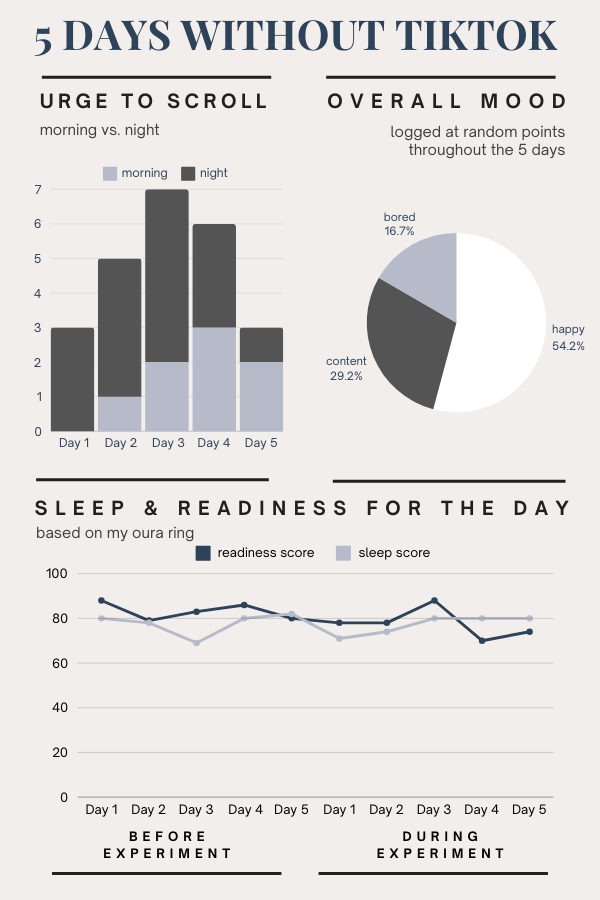
    I collected data on my phone using my notes app, including how many times I had the urge to scroll. I love getting to the end of my day, lying down in bed, and knowing I can just scroll TikTok for as long as I want. The problem is that I will scroll for hours and hours when I should be sleeping. The dopamine-seeker in me doesn’t care about sleep even when the clock strikes 12 am, and I have to be up for 6.

    I also have an Oura Ring which I’ve been wearing for about a year to track my sleep. It’s one of my favorite wellness-related investments I’ve made. It not only tracks sleep, bur also your readiness for the next day, recovery, and workouts. On nights where I’m scrolling for a long time, I don’t get enough sleep and therefore don’t recover well. I recorded all of that data from the 5 days prior and 5 days during my experience. One thing that was most prominent to me as far as my sleep, was that I got to sleep faster when I gave up TikTok. Instead of scrolling, I read my book and would fall asleep within 15 minutes.

    The last piece of data I wanted to record was my overall mood. I felt so much happier after giving up TikTok for a short period of time and paid more attention to the world around me. I was traveling this week and enjoyed people-watching on a much deeper level because I knew I couldn’t look at my phone for entertainment. Another reason that I feel contributed to my happiness was the fact that I didn’t procrastinate. Anytime I had a moment to myself, I didn’t sit and scroll. I knew I needed to get things done, so I did them.

    Below is a visual representation of my week without TikTok. I challenge you to give up the app that you feel steals your time. Take your time back and see how you feel. You might just love it.

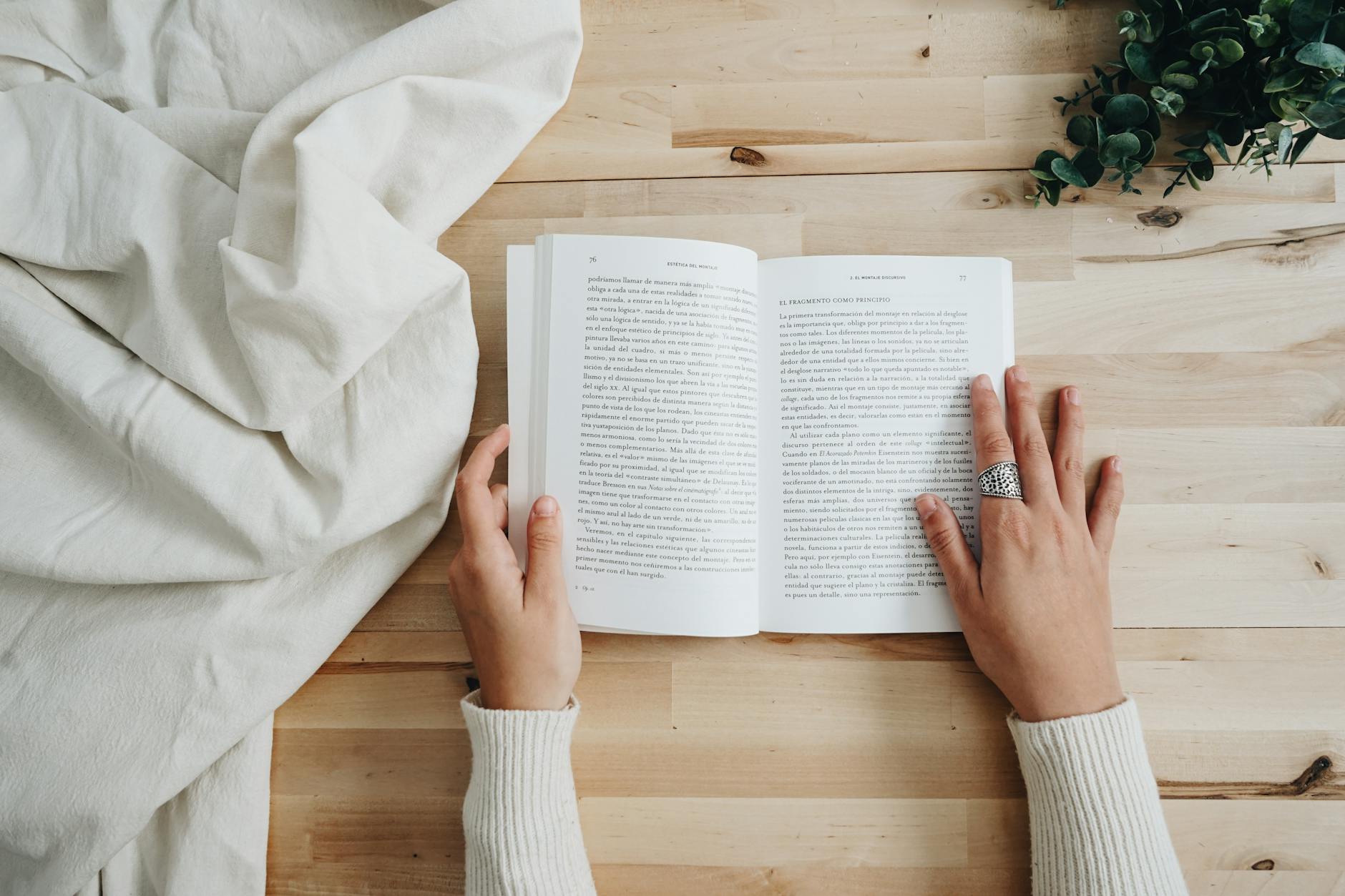
  • Discover the Power of Reading: Reduce Stress and Improve Relationships

    I’m a firm believer in the Law of Attraction. If you’re not familiar with the law, it basically says that whatever you put out into the world is what you’ll get back. The thoughts you think on a day-to-day basis will ultimately show up in your life.

    Output positive thoughts, emotions and energy = receive positive thoughts, emotions and energy

    This week, after I had read a few articles about reading in general and a few more chapters in Stolen Focus, I was thinking a lot about the benefits of reading and how important it seems to be for our mental health. And then, I was scrolling through Instagram, which brought me to Reddit, and saw this post:

    My husband started reading to me before bed and I am the happiest I’ve ever been with him. We got married very young, and have 2 boys under 3 years old. I am finally out of my postpartum haze… Recently, he started reading to me before bed. I asked him about the book he was reading and he asked if I wanted him to read it to me. It has been one of the most intimate and special things he has done for me. I look forward to this every night now and have already picked out the next book. I don’t want this feeling to ever end.”

    I thought to myself; how funny, that I’ve been contemplating the importance of reading, and this post pops up on my feed.

    Until I could read on my own, my grandmother used to read to me when I’d stay over her house. I can still picture the covers and illustrations that would lull me to sleep. It must mean something that I can still remember these things and not a random Instagram post that I might’ve come across when I was 15.

    There are studies that show the benefits of reading. Research has found that even just 6 minutes of reading per day can reduce stress levels by 68%. And, if you read with your significant other, it’s likely that you’ll experience higher relationship satisfaction. In my opinion, whether you’re looking to read with a loved one or alone, something is stress-reducing about the act of finding a new book to read. It’s literally one of my favorite feelings.

    Picture this. You walk into Barnes and Noble on a Sunday. You have nowhere to be, no one to speak to, no errands to run. You can smell the coffee brewing at the Starbucks counter. It’s crowded but not overwhelming — there are no beeping cash registers or employees speaking over the intercom. You’re surrounded by books of all genres, paperback, and hardcover. There are comfy leather chairs scattered in various aisles. You browse the shelves until you find a new book, sit down with a coffee, and just read. Phone on DND. Name something better than that. There are very few things that come close to that feeling.

    If you have a free moment sometime this week, I encourage you to pick out a new book. Whether that’s in a Barnes & Noble, or in the book aisle at the grocery store. Read with someone you love or by yourself. Take time to destress and immerse yourself in the story. Do that again next week, and the week after, and the week after. Reap the benefits of reading and notice your life beginning to change.

  • Is this really the true human experience?

    As soon as I picked up Stolen Focus, I resonated with almost everything that the author, Johann Hari, had pointed out. Stolen Focus: Why You Can’t Pay Attention — and How to Think Deeply Again, is a book about how as humans, we’ve lost the ability to focus.

    I thought about my life, and how much of it I’d spent behind a screen. I must admit — I’m guilty of taking pictures of everything… because what if I forget? I want to remember the first meal I had on a summer night in Italy, my favorite pieces at the Louvre, and special moments at home with my dogs, boyfriend, and family.

    I too, was lucky enough to spend time in Provincetown, Massachusetts, where everyone is accepted for who they are and every waking minute is spent in celebration or relaxing by the ocean. I went every summer from age 8 to age 21. As a kid on the long drives to Provincetown, I’d bring books or a portable DVD player just in case I wanted to watch a movie. By the time I could sit in the passenger seat, I’d scroll Youtube videos, Twitter, and get excited about what photos I could post on Instagram during my trip. Then, I started driving myself to Provincetown. Because I couldn’t scroll while driving, I’d have a “debrief” with my phone once I’d arrived at the hotel. I was curious about all the content I’d missed in the last few hours. And I did this everywhere. I still do.

    I wake up, I scroll. I have some downtime before bed, I scroll. I’m eating dinner by myself, I scroll.

    Is this what’s important?

    The Dopamine Detox We Might Need

    I’ve thought about doing a detox of all social media for a little while… a dopamine detox, if you will?

    Ironically, I saw the idea on TikTok. It’s the practice of getting rid of everything that increases dopamine levels — social media, video games, caffeine, etcetera. As a society, we’re so used to getting immediate satisfaction out of everything. Comments, likes, follows, energy drinks, beating a hard level. This practice isn’t supposed to get rid of the things we enjoy, it’s to become more aware of positive and negative habits and teach the ability to delay gratification.

    There’s not a lot of evidence that this actually works, but I’d be willing to try.

    The Importance of Human Connection

    I’ve been doing some reflecting over the past few days, and paying attention to how much I use my phone. I try not to reach for it first thing in the morning or before I go to bed. Sometimes, I look around and see everyone in the room on their phone. I work at a brunch restaurant, and there will often be tables with families or couples who don’t even speak to each other. They just look at their phones. It makes me sad, because what’s more important than human connection?

    Here I am referencing TikTok again, but sometimes it really does highlight great things. One of my favorite trends to see is one called “Humans being Humans”. At the end of the day, I’d love for everyone to realize (me included), how important this is. Or this. And staring through a screen won’t get you there.

    Society needs to relearn how to be human. To the fullest. Instead of looking to the TV to lull us to sleep, coffee to wake us up, and feeds to scroll while waiting in line, we could be doing anything else. I’m excited to learn more from this book, as it’s already got me thinking about habits in my life that I may want to change. For now, as I head to bed, I’ll be reaching for a book instead of my phone, and dreaming of Augusts in Provincetown.