Tag: health

  • Wrapping Up a Five-Week Series

    Wrapping Up a Five-Week Series

    For the past five weeks, I’ve written about the gaps in equity between men and women’s sports, and posted articles on LinkedIn. I’ve done tons of research, spent hours on assignments, and written hundreds of words. As a sports marketer for the Connecticut Sun, I spend almost every day working for athletes. I send out emails, work in the team app, write copy for paid social posts, curate the newsletter, write for the podcast, and more.

    While working for a professional women’s team, I think a lot about the importance of equal pay, equal representation, equal media coverage, and the safety of women athletes. While these are important issues, there’s another forgotten equity gap — the medical research gap.

    Beyond Pay and Coverage

    It’s not surprising to know that medical research has often been performed on men, by men. So, many of the treatment plans or recovery plans that women athletes might use to help themselves may not work as well. Without taking athletes into account, there’s a jarring statistic that “despite living longer than men on average, women spend 25% more of their lives in poor health” and “approximately 1% of healthcare research and innovation is invested in female-specific conditions beyond oncology.”

    ACL Tears

    As a women’s basketball fan, I’ve heard tons of stories and even seen ACL tears on the court. And actually, women are six times more likely to tear their ACL’s than men. This is due to a few different reasons.

    Anatomy: Women generally have wider hips compared to men and are often more knocked-kneed, which means their knees tend to tilt inward. This alignment alters the knee joint, increasing the risk of ACL injuries during movements such as jumping, pivoting and landing. The ACL tissue is also typically thinner in women, so it takes a less force to tear.

    Biomechanics: When women land, it’s usually in an upright posture, resulting in straighter knees and less core engagement. This is different from men who usually land with bent knees and with more core engagement.”

    Hormones: Research shows that the elasticity of collagen in the knee is impacted throughout different stages in the menstrual cycle, resulting in a higher risk of ACL injury.”

    My LinkedIn Article

    In my LinkedIn article (which is scheduled for tomorrow morning), I wrote a bit more in depth about ACL tears and how we can try to move forward as a society in performing more research. And prioritizing women in this research. We need more investment in research that centers women athletes, more training and recovery programs built specifically for women’s bodies, and more women leading the conversations in sports science. If we want women’s sports to thrive, protecting athletes’ health is just as important as paying them fairly or broadcasting their games on national television.

    Looking Ahead

    Through proper research, and the right advocates, I really believe that women’s sports has the chance to become as popular as men’s sports. The more women continue to work in sports, uplift other women, the more women play sports, and the more people invest in women’s sports — it’ll all add up over time and make a difference.
  • The Double-Edged Sword of Advanced Technology

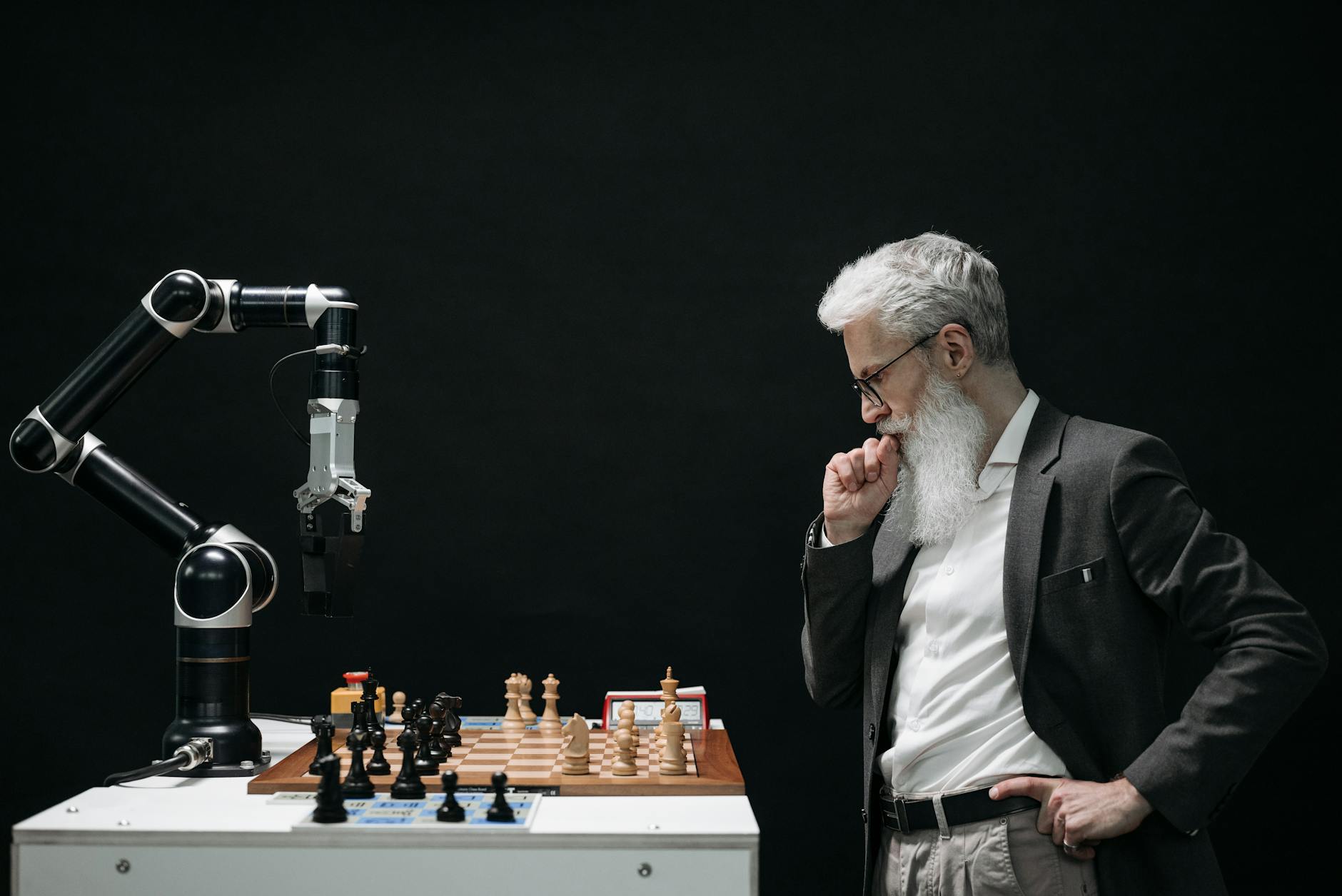
    Photo by Pavel Danilyuk on Pexels.com

    Even though we’ve witnessed some of technology’s amazing benefits in today’s society, it often comes at a price.

    Tech is so much smarter than we are. The Center of Humane Technology explained it perfectly: Technology is extremely profitable, so it often develops faster than our ability to regulate it or understand its long-term effects.” Isn’t that crazy? Our brains can’t even comprehend information at the same rate as the technology being used today.

    Over these last few weeks, I’ve done a lot of thinking about tech, society, and how it’s changed how we behave. And right now, we only know its short-term effects, as the more advanced technology hasn’t come about until recent years. The rise of artificial intelligence is something that I, personally, have troubling comprehending.

    AI can do everything that humans can — but faster, and maybe in some situations, better. It can create images, and stories, gather information, answer questions, and more. There seems to be no limit to what it can do.

    Because technology is becoming so advanced, “it means we are rapidly disseminating technology with dangerous, exponentially advancing applications.” For example, the genetically modified babies. Let me explain.

    I didn’t even know this was an actual thing until I read this journal. He Jiankui (a scientist) and his team, used CRISPR technology to disable the CCR5 gene in two babies, which enables HIV infection. While I think his intentions were fair, it’s up for debate on whether this practice is ethical. The babies couldn’t consent in embryo, and we don’t know the long-term effects of disabling this gene. What if it causes other problems in different areas? What’s even crazier to me is that “CRISPR-Cas9 has made it possible to add, delete or replace genes, thereby opening the door to new types of genetic interventions.” Our technology has become so advanced to the point where we can change, edit, or delete genes. Whoever thought this would be possible?

    It’s overwhelming to think about the types of advancements we’ve had in technology lately. I can’t imagine a world where we have thousands upon thousands of genetically modified babies walking the planet. On the bright side, technology is so advanced that as a society, we can learn to use it for good. He Jiankui ended up serving 3 years in jail for performing “illegal medical practices,” but so far, the two babies are still healthy. Do you think that’s a fair punishment? Or that genes should be allowed to be modified? Do the benefits of technology outweigh the risks? I’m not so sure.

  • I Gave Up TikTok for 5 Days and This is What Happened

    Do you ever wonder what might happen if you took a break from social media? Would you feel any different? Worse? Better?

    I was inspired to take a break from a social media app for 5 days. At first, I decided I was going to give up Instagram. But after more thought, I had to admit I wasn’t being honest with myself about what would be the most challenging. If I was going to give something up, I wanted it to be worth it. Although I love Instagram (it’s probably my favorite app), it’s not the app I find myself wasting a ton of time on. That app is the one and only… TikTok. There’s something about scrolling TikTok — the endless feed, the quick videos, the ability to pick and choose what you want to watch. I could scroll for hours. And I know plenty of people that feel the same way.

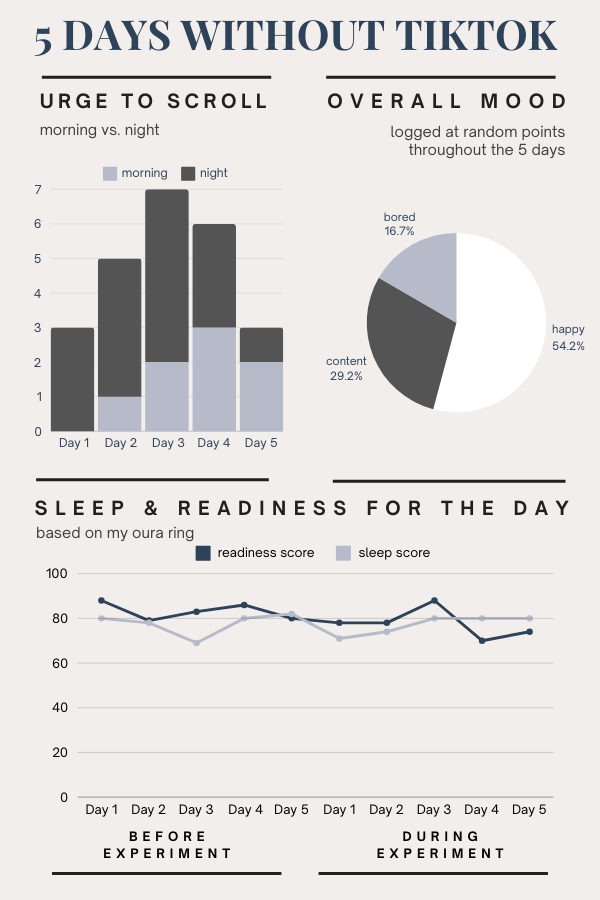
    I collected data on my phone using my notes app, including how many times I had the urge to scroll. I love getting to the end of my day, lying down in bed, and knowing I can just scroll TikTok for as long as I want. The problem is that I will scroll for hours and hours when I should be sleeping. The dopamine-seeker in me doesn’t care about sleep even when the clock strikes 12 am, and I have to be up for 6.

    I also have an Oura Ring which I’ve been wearing for about a year to track my sleep. It’s one of my favorite wellness-related investments I’ve made. It not only tracks sleep, bur also your readiness for the next day, recovery, and workouts. On nights where I’m scrolling for a long time, I don’t get enough sleep and therefore don’t recover well. I recorded all of that data from the 5 days prior and 5 days during my experience. One thing that was most prominent to me as far as my sleep, was that I got to sleep faster when I gave up TikTok. Instead of scrolling, I read my book and would fall asleep within 15 minutes.

    The last piece of data I wanted to record was my overall mood. I felt so much happier after giving up TikTok for a short period of time and paid more attention to the world around me. I was traveling this week and enjoyed people-watching on a much deeper level because I knew I couldn’t look at my phone for entertainment. Another reason that I feel contributed to my happiness was the fact that I didn’t procrastinate. Anytime I had a moment to myself, I didn’t sit and scroll. I knew I needed to get things done, so I did them.

    Below is a visual representation of my week without TikTok. I challenge you to give up the app that you feel steals your time. Take your time back and see how you feel. You might just love it.