Tag: mental-health

  • Reflecting on Growth: My Final Blog Post in the ICM Program

    Reflecting on Growth: My Final Blog Post in the ICM Program

    Learning Through Women’s Sports

    I’ve learned so much about myself during these last few weeks — and the last year. Over the course of five weeks, I worked on a LinkedIn article series highlighting women’s sports and the inequalities that athletes face. I spent countless hours researching and listening to books, diving deeper into the stories of women who inspire me.

    One of those women is Dawn Staley. While I still haven’t finished her book Uncommon Favor (which I highly recommend), I’ve taken a closer look at her career and leadership style. She’s authentic, vulnerable, and unapologetically real — qualities that have made her a role model to so many. Recently, I even listened to her on Michelle Obama’s podcast, IMO, which I also recommend for anyone who wants to feel empowered.

    Closing a Chapter in My Master’s Program

    As I write this, I feel a weight lifted from my shoulders. This is the last blog post I’ll be writing during my time in the ICM program. Over the past year, I pushed myself to take as many courses as possible in order to finish my master’s degree quickly — and now, looking back, I can see how much my life has shifted during that process.

    I truly owe so much to this program. I’ve learned the importance of strategy, developed skills in content creation, and embraced my creativity more fully than ever before.

    Lessons from My LinkedIn Series

    When it came to my LinkedIn series, the results weren’t exactly what I envisioned. But what I gained was even more valuable: confidence. I’ve become less intimidated about posting on LinkedIn, more comfortable sharing my voice, and better at managing my time.

    I also learned how to document my work effectively, prioritize tasks, and evaluate what needs to be done first versus what can wait. These are skills that will stick with me long after this project.

    Final Results

    Here’s a snapshot of the total performance of my LinkedIn series:

    2,901 impressions | 54 likes | 6 comments | 8 reposts | 21 new followers

    While the numbers tell one part of the story, the growth I experienced throughout this process tells the rest.

    Moving Forward

    This project marks both an ending and a beginning. It’s the close of my time in the ICM program, but also the start of applying everything I’ve learned to the next chapter of my career.

    More details about my project can be found within my portfolio, or linked here.

  • Wrapping Up a Five-Week Series

    Wrapping Up a Five-Week Series

    For the past five weeks, I’ve written about the gaps in equity between men and women’s sports, and posted articles on LinkedIn. I’ve done tons of research, spent hours on assignments, and written hundreds of words. As a sports marketer for the Connecticut Sun, I spend almost every day working for athletes. I send out emails, work in the team app, write copy for paid social posts, curate the newsletter, write for the podcast, and more.

    While working for a professional women’s team, I think a lot about the importance of equal pay, equal representation, equal media coverage, and the safety of women athletes. While these are important issues, there’s another forgotten equity gap — the medical research gap.

    Beyond Pay and Coverage

    It’s not surprising to know that medical research has often been performed on men, by men. So, many of the treatment plans or recovery plans that women athletes might use to help themselves may not work as well. Without taking athletes into account, there’s a jarring statistic that “despite living longer than men on average, women spend 25% more of their lives in poor health” and “approximately 1% of healthcare research and innovation is invested in female-specific conditions beyond oncology.”

    ACL Tears

    As a women’s basketball fan, I’ve heard tons of stories and even seen ACL tears on the court. And actually, women are six times more likely to tear their ACL’s than men. This is due to a few different reasons.

    Anatomy: Women generally have wider hips compared to men and are often more knocked-kneed, which means their knees tend to tilt inward. This alignment alters the knee joint, increasing the risk of ACL injuries during movements such as jumping, pivoting and landing. The ACL tissue is also typically thinner in women, so it takes a less force to tear.

    Biomechanics: When women land, it’s usually in an upright posture, resulting in straighter knees and less core engagement. This is different from men who usually land with bent knees and with more core engagement.”

    Hormones: Research shows that the elasticity of collagen in the knee is impacted throughout different stages in the menstrual cycle, resulting in a higher risk of ACL injury.”

    My LinkedIn Article

    In my LinkedIn article (which is scheduled for tomorrow morning), I wrote a bit more in depth about ACL tears and how we can try to move forward as a society in performing more research. And prioritizing women in this research. We need more investment in research that centers women athletes, more training and recovery programs built specifically for women’s bodies, and more women leading the conversations in sports science. If we want women’s sports to thrive, protecting athletes’ health is just as important as paying them fairly or broadcasting their games on national television.

    Looking Ahead

    Through proper research, and the right advocates, I really believe that women’s sports has the chance to become as popular as men’s sports. The more women continue to work in sports, uplift other women, the more women play sports, and the more people invest in women’s sports — it’ll all add up over time and make a difference.

  • Women’s Sports, LinkedIn, and What I’m Doing About It

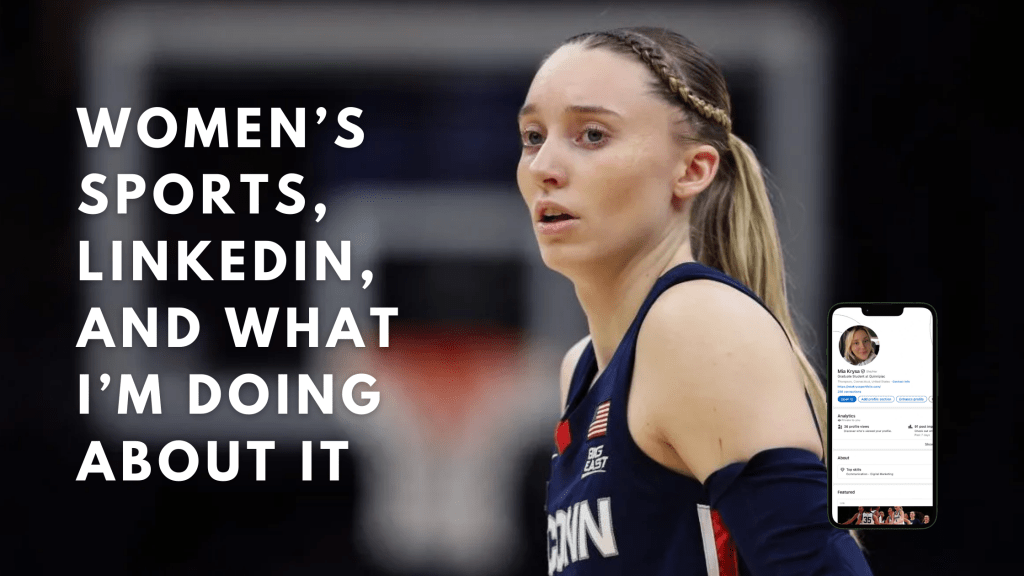
    Women’s Sports, LinkedIn, and What I’m Doing About It

    In the culmination of my graduate degree, I’ve been thinking about what career I want to pursue and where I think I can do better as far as my online presence. I know one thing without a doubt — I want to work in women’s sports. In February, I accepted an internship with the Connecticut Sun, and it’s been such an amazing learning experience for me. Not only did I finally figure out where I fit in the professional world, but also what I’m genuinely passionate about. As a woman, I love seeing other women succeed, and as a life-long lover of most sports, I love seeing women succeed as athletes. I’ve learned so much in my internship and continue to learn more every day, about things like paid social, email marketing, app management, writing copy, creating promotional graphics, working with brand partners, ticket sales, and more.

    But why is any of this important?

    It’s important because we’re doing it for a women’s sports team. And historically, women’s sports has been neglected and ignored in almost every aspect of society — until now. The WNBA, for example, is finally getting the recognition it deserves, and has reached a new high in viewership this year. “The WNBA kicked off its 2025 season with unprecedented viewership numbers, setting new records for opening weekend on ESPN platforms. The marquee matchup between the Chicago Sky and Indiana Fever became the most-watched WNBA game ever on ESPN, drawing an average of 2.7 million viewers and peaking at 3.1 million. This marks a 115% increase over last year’s regular season ABC average.” But make no mistake — there’s still a long way to go.

    My Lacking LinkedIn Presence

    Personally, I struggle with LinkedIn. I don’t know if it just feels too formal to me, or if I’m not connecting and following with the right people. I think I’ve always felt some sort of imposter syndrome, which is when someone thinks they’re “undeserving of their achievements and the high esteem in which they are, in fact, generally held.” I’m familiar with this feeling, especially because it’s easy to compare yourself to other people in your 20s. I’m in a place right now where I feel like I could be farther in my career, but I’m really just starting, and I struggle with that sometimes.

    Because of my imposter syndrome, I’m not as confident with posting on LinkedIn as I should be. But I’m here to change that. Combining my professional interests, and my lack of presence on LinkedIn, plus my passion for protecting and recognizing women in sports — I’ll be releasing a 6-week LinkedIn series, educating others on the history of women’s sports, the gaps between women and men in multiple areas, and how we can move forward.

    A Game Plan for Change

    Look out for my LinkedIn articles! I’ll post one article and one post per week, focusing on a different aspect of women’s sports. They’ll be about 600-1,000 words long, and backed by thoughtful research from articles, journals, podcasts, books, and videos. The goal is to not only educate others on historic and societal barriers that women athletes face, but to establish myself as a thought-leader on LinkedIn. This series will aim to reach audiences
    who want to create change — from athletic directors to sports executives and everyone in between.

    Connect with me here.

  • From Fangirl to Feeds: Growing up with Social Media

    From Fangirl to Feeds: Growing up with Social Media

    The Early Days of the Internet

    When I think about the way that social media has changed over the years, it baffles me. I was born in 1999, the same year of the Internet. I grew up without much social media, and iPhones didn’t come out until I was 8 years old. Back then, I remember iPhones being considered some kind of luxury.

    I remember social media really becoming popular around 2013, when I was in 8th grade. At this time, I was obsessed with the boy band One Direction. I’d spend my days on Twitter and YouTube, watching music videos of the band, following their journey, and tweeting about them with other young girls who had the same interests. At that time, many people said that One Direction surpassed the popularity of the Beatles, which sounded like a crazy statement at the time. Looking back, they were exactly right, and that was because of social media.

    One Direction and their Online Community

    “One Direction had a recruitment and promotional technique that no boy band before had ever utilized properly: the internet” (Greenwood, 2020). CDs turned into Spotify. Newspapers turned into Twitter threads. Traditional publicists turned into fan accounts with thousands of followers. Social media connected the distance between celebrities and fans in a way that was never possible before. One Direction’s popularity wasn’t just about their music — it was about how easily their music could be shared. Fans from all around the world could tune in. It also felt like they had a personal stake in the band’s success because they were part of the online community that kept the hype alive.

    In 2013, there were no algorithms manipulating our feeds, no influencer marketing, no brands trying to sneak into our conversations. Social media felt new, simple, and much less commercialized. As I’ve gotten older, and continue to use social media daily, I’ve noticed a shift. Social media platforms today feel more like digital malls than gathering spaces. Content is now designed for virality rather than authenticity. The same tools that helped build global communities around a band like One Direction are now used to sell products and even used to spread misinformation. Instead of social media being a fun place to go, it can sometimes feel overwhelming and saturated.

    Nostalgia for the old Social Media

    Still, I can’t help but feel nostalgic. Social media introduced me to people I would’ve never met in real life. It gave me a voice at a young age, and put me in touch with other girls who had the same interests. I often wonder if today’s teens feel the same way. The Internet has grown up and so have I, but I’ll always reminisce on the times I used it to support a boyband from the UK.

  • When Hashtags Aren’t Enough: The Fine Line Between Advocacy and Slacktivism

    Photo by Ehimetalor Akhere Unuabona

    Social media is used by many to learn, share information, and connect with others. It’s also a place that can be used to create good in the world, given its many capabilities. Have you ever cared about a movement or a project that you wanted to advocate for but didn’t know where to start? Or what about simply sharing an opinion you think could benefit others? Let me explain.

    Social Media Activism 101

    Social media, in addition to ways you’re probably already using it, can be used to participate in movements you care about. It can be used to call on communities, spread awareness, and inspire action throughout society. Social media creates a sense of a “digital village,” where someone can post something that others might agree with and support, thus mimicking a sense of closeness with community. If you can reach millions of people just by posting one TikTok of you eating your lunch, think about the impact that might have when using it to advocate.

    Nicole Reiley, a writer for University Times, explained how we most often use social media to advocate: “Every day on social media, it is not uncommon to see various forms of advocacy at work—whether raising awareness about the war in Gaza, educating people about reproductive rights, or promoting sustainability measures. Viral hashtags can now educate communities about human rights, underrepresented groups, and address pressing political issues. This can be done from anywhere in the world, without the barrier of geographical distance.”

    The Dangers of Slacktivism

    While social media can most definitely be used for good, we also must address that there’s a fine line between activism and “slacktivism.” Slacktivism is a term used by some to explain how when people choose to participate in some sort of movement (especially on social media) they might repost a hashtag or an Instagram photo, and believe they’ve done all they can. done. Posting a black square on #BlackoutTuesday, then never speaking on the issues of racism again, is an example of slacktivism.

    Make Your Posts Count

    As we continue to learn and evolve as a society, we must learn how to effectively communicate and advocate for causes we care about. If there’s some sort of movement or topic you feel compelled to support, but may not fully understand, I challenge you to take the time to do some extra research. Understand how to best support each movement. Ponder on information and form your own opinions. Advocate with care.

  • The Struggle to Focus in a Distracted World

    As I’ve continued reading Stolen Focus, I’ve begun to think more about ADHD, anxiety, stress, and the internet. Quite a handful, I know. Hari, the author of Stolen Focus, talked about an interview he’d had with Dr. Nadine Burke Harris. Dr. Harris explained how so many children and people are struggling to focus because their brains are focusing on surviving. Not only are we being overstimulated by things like social media and the news, but for some people, traumatic events cause them to constantly be on the lookout for the next shoe to drop.

    One heartbreaking story Dr. Harris told was about a boy named Robert who had been abused by his mother’s boyfriend. This happened around age 10, which is when his attention problems started happening. Think about the stress that this causes a child, and then picture that child trying to learn long division in school. Robert’s brain was using all of its energy to detect danger — his mother’s boyfriend — instead of learning new things. It wasn’t his fault he couldn’t pay attention.

    Robert was prescribed medication to help him focus in school, but his problems at home were being ignored. Why, as a society, are we ignoring things like this? Why are we ignoring the problems that are happening at home? The real-life issues? It seems like everything now is covered up with medicine or by ignorance.

    As a society, we’re given antidepressants instead of meditation and therapy. Drinking coffee instead of sleeping more. Watching TikTok when we could be outside. Not speaking to each other during meals. All of this comes back to the problem that I wrote about in my first blog post — is this really the true human experience? I don’t think it is.

    I’ve been traveling a lot these past few weeks. I was in Cleveland last weekend and am in Atlanta writing this post. And I notice the same behavior everywhere. As I look around the airport, everyone was on their phones. On the plane, there are TVs behind every seat. What happened to resting, sitting, and talking to each other? It sometimes feels impossible to escape media and just take a break when it’s all around you, all the time. I’m slowly learning that a slow, simple life seems to be the healthiest way to live. The challenge is, how do we live this way when society doesn’t let us? As a population, we are so used to being inundated with information that it’s hard to catch a break.

    I don’t know how we change society as a whole. But, the best thing we can do, is change our behavior for ourselves and those close to us. If enough people realize the true meaning of human connection and life itself, we might be on our way to healing.

  • I Gave Up TikTok for 5 Days and This is What Happened

    Do you ever wonder what might happen if you took a break from social media? Would you feel any different? Worse? Better?

    I was inspired to take a break from a social media app for 5 days. At first, I decided I was going to give up Instagram. But after more thought, I had to admit I wasn’t being honest with myself about what would be the most challenging. If I was going to give something up, I wanted it to be worth it. Although I love Instagram (it’s probably my favorite app), it’s not the app I find myself wasting a ton of time on. That app is the one and only… TikTok. There’s something about scrolling TikTok — the endless feed, the quick videos, the ability to pick and choose what you want to watch. I could scroll for hours. And I know plenty of people that feel the same way.

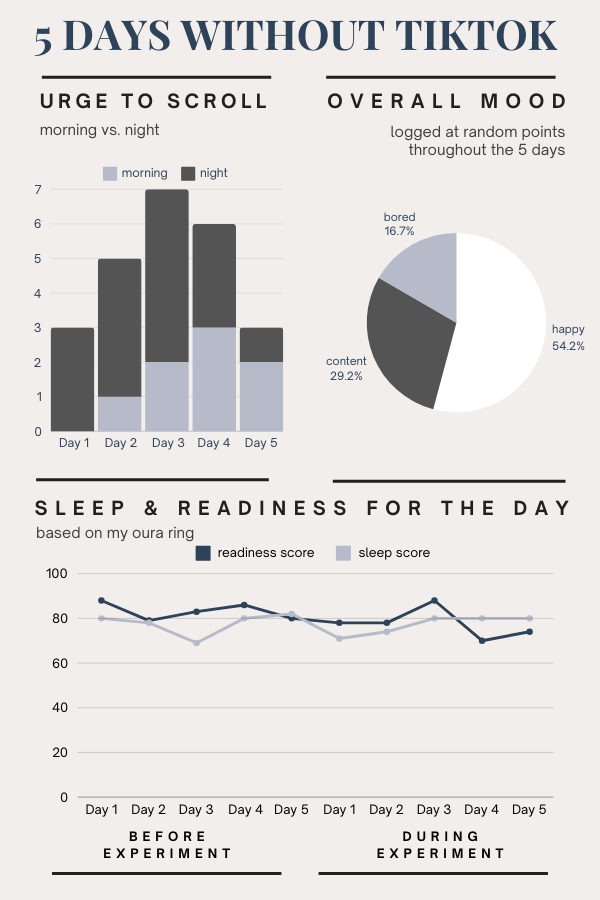
    I collected data on my phone using my notes app, including how many times I had the urge to scroll. I love getting to the end of my day, lying down in bed, and knowing I can just scroll TikTok for as long as I want. The problem is that I will scroll for hours and hours when I should be sleeping. The dopamine-seeker in me doesn’t care about sleep even when the clock strikes 12 am, and I have to be up for 6.

    I also have an Oura Ring which I’ve been wearing for about a year to track my sleep. It’s one of my favorite wellness-related investments I’ve made. It not only tracks sleep, bur also your readiness for the next day, recovery, and workouts. On nights where I’m scrolling for a long time, I don’t get enough sleep and therefore don’t recover well. I recorded all of that data from the 5 days prior and 5 days during my experience. One thing that was most prominent to me as far as my sleep, was that I got to sleep faster when I gave up TikTok. Instead of scrolling, I read my book and would fall asleep within 15 minutes.

    The last piece of data I wanted to record was my overall mood. I felt so much happier after giving up TikTok for a short period of time and paid more attention to the world around me. I was traveling this week and enjoyed people-watching on a much deeper level because I knew I couldn’t look at my phone for entertainment. Another reason that I feel contributed to my happiness was the fact that I didn’t procrastinate. Anytime I had a moment to myself, I didn’t sit and scroll. I knew I needed to get things done, so I did them.

    Below is a visual representation of my week without TikTok. I challenge you to give up the app that you feel steals your time. Take your time back and see how you feel. You might just love it.