Tag: social-media

  • People, Paid Social, and Purpose: Lessons From My Graduate Student Journey

    People, Paid Social, and Purpose: Lessons From My Graduate Student Journey

    I can’t believe a year has gone by since I started the ICM program. I’ve spent countless hours on blog posts, projects, and what has felt like endless research on how to communicate effectively online. I have so much to thank this program for, and here’s a few things I’ve learned.

    1. People first. Companies seem to forget that empathizing with humans is one of the most important things in marketing. It doesn’t matter how well your product works, or how clean your website is. If you aren’t prioritizing the human side of marketing, your brand will easily get lost among the millions of others online. Take the time to understand your audience and prioritize communication with them.
    2. Don’t forget about paid social. I’ve always been a lover of organic social, but in my internship with the Connecticut Sun, I learned so much about the importance of paid social — and I feel like I almost like it more. With the combination of both, you have the ability to build trust with your audience, stay spontaneous, and target new fans.
    3. Typography matters (and so does white space). Surprisingly, one of the things that has stuck with me most is the importance of typography in brands. After learning about the importance of font families, typefaces, and kerning, I feel like I notice it everywhere. I think about why people have chosen the typefaces they do to represent their brand, and what might they want that typeface to convey. I also learned the importance of white space and how it can help you of more ways than one.
    4. Learning never ends. I’ve always loved being a student. I’d gone back and forth about the pros and cons of going back to school after I got my bachelor’s, and the pros heavily outweighed the cons. Throughout this program, while there are some things I’ve noticed stayed the same, the marketing and digital space is constantly changing. I think being open to the ever-evolving world of social media and digital marketing, while continuing to ask questions, is the best way to grow. A long-term life goal of mine is to be a forever student. Ask questions. Stay curious. Keep an open mind.
    5. I finally found my future in women’s sports. I always struggled to figure out where I fit in the professional world. It wasn’t until I landed my internship at the Connecticut Sun (which was ignited by my love of UConn women’s basketball), that I felt like I found my place. I’ve loved sports since I was a kid, and I find celebrating women athletes to be empowering and motivating. I’ve recently been promoted to Marketing Specialist, and I owe so much to this program — having a master’s degree alone is a good way to make people double-take your job application.

    Looking Ahead

    I’ve accomplished so many things in such a short amount of time, that I’m allowing myself to finally take a deep breath in the completion of my degree. It is one of the things I’m most proud of thus far. I can’t wait to see what the future holds.


  • Learning (and Posting) As I Go: A Busy Week, My Birthday, and a LinkedIn Lesson

    Learning (and Posting) As I Go: A Busy Week, My Birthday, and a LinkedIn Lesson

    This week was an exceptionally busier week than the last — and I already thought it couldn’t get any busier. It was my birthday, I got a promotion at work, and have really tried to pace myself with my homework. In the past, I’ve found myself saving all of my homework for the weekend or for a Sunday, and am miserable trying to complete everything by the due dates. At work, and through weekly production journals for my class, I’ve found myself become better at pacing my work, and am much less stressed

    A Reminder from my Boss

    The other day, my boss was explaining to me that even though I like to cross everything off my to-do list, I need to get out of that mindset. Likely, my to-do list will never end. It’s more about prioritizing what needs to get done first. And then ask yourself, what could wait until next week?

    Diving Into a New Topic: Gender Pay Gap in Sports

    This week, I wrote about the gender pay gap in sports. This issue has been a well known issue in the world in general for so long, that I feel like maybe it’s just not interesting. For my first article, I wrote a brief history on women’s sports, and below are the metrics:

    Article #1
    Post Date
    : Jul 28, 2025
    Post Publish Time 1:00 PM

    Impressions: 1,005
    Members reached: 588
    Profile viewers from this post: 12
    Followers gained from this post: 0
    Reactions: 16
    Comments: 6
    Reposts: 2

    Here are the metrics for my second article:

    Article #2
    Post Date: Aug 1, 2025
    Post Publish Time: 3:00 PM

    Impressions:171
    Members reached: 88
    Profile viewers from this post: 1
    Followers gained from this post: 0
    Reactions: 3

    Timing is Everything

    After seeing these metrics, it’s safe to say that I will not be posting on a Friday again. Hootsuite published an article that had recommended times for each days of the week, if you wanted to post every day. What’s most important about that article though, is that even if you post at a good time for that day, it might not be the best time in the week. Comparing the metrics from a Monday LinkedIn post to a Friday LinkedIn post showed a drastic change, and I can definitely learn something from my audiences’ behavior. On Monday, people are scrolling LinkedIn more, ready to take on the work week. By Friday, people might not be as active on LinkedIn because they’re ready for the weekend.

    Do I blame them? No. Do I wish my second article performed better? Yes. Admittedly, I don’t know why I would’ve posted at 3:00PM either. That was probably an error on my part, because no article that I have read suggests posting at 3PM on a Friday.

    Knowing Your Audience — and Reaching the Right One

    Another thought I had, was that maybe my article just wasn’t appealing to the followers that I currently have. Women are probably more interested in the topic at hand. The women’s pay gap doesn’t really appeal to men. Over half of my followers/connections are men… so maybe that’s the problem. This week, I’m going to continue working on expanding my followers and connections to women leaders, marketers, and women in the sports industry. I think this will help in appealing to the right audience.

    Lessons I’m Taking Into Next Week

    • Don’t post on Friday afternoons.
    • Keep building a network that reflects the audience I want to reach.
    • Your to-do list will never be empty — so stop treating it like it should be.

    Here’s to another week of growing, learning, and maybe (just maybe) choosing a better time to post.

  • Rebuilding Spalding: A Strategic Blueprint for a Stronger Digital Presence

    Rebuilding Spalding: A Strategic Blueprint for a Stronger Digital Presence

    I spent about 5 weeks researching Spalding’s brand and social media presence. In short: I didn’t find much. I quickly realized that Spalding had a lot of work to do when it came to their digital identity, so I came up with a plan to help them.

    A Brand with Legacy, but Lacking Presence

    Rather than make one single campaign that might help their engagement and success on social media, I analyzed the brand’s voice, what their goals were, the history of the brand, and how they can better portray that on social media. I focused more on longevity than one campaign. Spalding most appeals to young athletes, especially ones that play basketball, softball, or volleyball. They’ve been around for a long time, and are a credible sports brand that many people turn to if they’re putting up a basketball hoop at home or picking up practice equipment. However, they lack that young, fun, and trendy presence on social media, which is crucial when you consider their target audience.

    Their social media presence is almost non-existent, and doesn’t reflect a player-first mentality. It has a cold, impersonal feeling that seems like they’re trying to market to arenas and gyms (which is okay if that was their only target audience, but it’s not). Sports and social media have such a strong relationship in today’s world, and lots of people who watch sports are most likely on social media. It’s crucial that Spalding up their game (pun-intended) if they want to stay relevant in the sports world.

    The Game Plan: How Spalding Can Win Online

    It would help to incorporate things like:

    • More athlete collaborations (college and pro athletes)
    • Social media takeovers
    • Collaborations with landscaping companies (to appeal to young athlete’s parents)
    • More participation in current trends/memes
    • Attempt to reach a larger audience by tapping into golf, softball, tennis, and volleyball worlds (their social media focuses heavily on basketball)
    • Celebrate the history of Spalding, which increases their credibility
    • Incorporate trends unrelated to sports with their sponsored athletes or teams, to reach a different audience

    Measuring Success: SMART Goals for Spalding

    To make sure that Spalding is reaching their goals, I implemented the SMART strategy to accurately measure growth. In short, the main goal would be to increase Spalding’s brand relevance and engagement among Gen Z and Millennial athletes, increase 100k+ followers on combined social platforms, achieve a 15% increase in Instagram and TikTok engagement rates, boost sales of basketballs by 20%, and other equipment by 10%. By leveraging their current partnerships and existing following, Spalding must post on a consistent schedule on Instagram, TikTok, and Youtube to resonate with their target audience — while keeping their brand voice in mind.

    Final Thoughts: A Brand Built for the Future

    It’s crucial that Spalding continues to evolve with the times. They’re legendary, but aren’t acting like it on their socials. With the right strategies implemented, they can increase their brand awareness on social media, appeal to their target audience, and increase sales. If you’d like to take a look at my project, it’s linked below!

  • Why No One’s Clicking Your Link: The Truth About Social Media Engagement

    Why No One’s Clicking Your Link: The Truth About Social Media Engagement

    This week, I’ve been thinking about how I respond when I see a link or a hashtag in a post. Most often, it doesn’t make a difference in whether or not I engage with the post. The only time I find them effective is when I’m interested in the topic of the post (maybe it’s a skincare routine or a recipe I want to make), and then I’m more inclined to click on that link.

    The Research Says: Stop Posting Links

    Interestingly enough, there’s been quite a bit of research done on whether or not links are effective in driving engagement on social media. The short answer: no. Let me tell you why.

    LinkedIn’s Sneaky Thumbnail Shrink

    LinkedIn, a site known for connecting professionals and finding jobs, recently decreased the size of the thumbnail when users share links in their posts. Instead of seeing a large image across your screen, there’s a small box directing you to the linked page. This seems like such a small change, but LinkedIn’s goal with this change is to keep people on their platform longer. The less likely users are to see a thumbnail, the less likely they’ll click on it to leave the platform.

    Meta’s Algorithm Has Other Plans

    Facebook and Instagram, both owned by Meta, want people to stay on their platforms for as long as possible. If you’re sharing links in your Facebook posts, the algorithm is very much against you. “Facebook’s algorithm clearly favors native content like Reels and videos. The staggering statistic that over 95% of posts displayed in user feeds don’t include external links speaks volumes.” Additionally, have you ever noticed that you really only ever see links in user’s Instagram stories, rather than in captions? This ensures that if links are shared, they’re really only seen by the poster’s followers, rather than reach a wider audience through something like a static post or Reel.

    The Solution: Link in Bio

    So, what should you do? You want to share a link or two, but also make sure your posts aren’t being hidden by any algorithms. This is where the “link in bio” trick comes in. Share whatever post you want, and at the end, write “Link in bio.” This will not only direct people to your profile, but allow your post to be seen by anyone — then guide them to the link you’ve attached in your bio. With other platforms and tools such as Linktree, you can also attach as many links as you want! The only downside to this, is that people who don’t want to take the time to go to your profile to then click on a link, probably won’t do that. But in that case, they’re probably not the target audience anyway.

    It’s not surprising that platforms want users to stay scrolling their feeds for as long as possible — it’s how they make money. If you or your business needs to share links from now on, avoid sharing links in your post, because they will most likely be hidden by the algorithm, or at least reach less people. Hop onto the “link in bio” trick, and you’re likely to get more engagement through your posts, while sharing links you want to share.

  • The Rise of AI and the Need for Transparency

    The Rise of AI and the Need for Transparency

    With AI becoming an everyday occurance in many of our lives, it’s becoming more important to be transparent when running a business or a brand. As you’re scrolling through social media, it’s also your responsible to be media literate, so you can differentiate between what’s AI and what’s real.

    What Builds Trust on Social Media?

    We’re entering a time where a product photo might be AI-generated, a caption might be written by a chatbot, and a face in a video may not even belong to a real person. While AI can definitely be used as a tool in businesses, it should not be the end-all-be-all. Now more than ever, being human, honest, and transparent on social media is what sets people and brands apart. Ask yourself — have you ever read a caption that you knew was AI-generated, and it turned you off of that brand completely? Or what if a brand is dealing with a scandal, and they don’t address it online? Does that make you trust the brand more, or less?

    We have to make authenticity the new standard. Show your face. Share the process, not just the product. Talk openly about what tools you use, including AI. People appreciate honesty, and when trust is built, the brand will grow. If there are issues, talk about them. When I worked in the restaurant industry, customers always loved the photos or moments shared in the kitchen or with the staff. The food would of course get lots of attention, but to mix up the social media feeds or encourage engagement, throw in a staff photo here and there!

    Be a Smart Consumer of Content

    On the other hand, as consumers of content, you need to stay sharp. Don’t take everything at face value. If something sounds off, it probably is. Part of being media literate in 2025 is being able to read something or see something, and understand if it’s real or not.

    If You’re Going to Take Away One Thing, Let It Be This

    If you’re a creator or brand, lean into your brand. Show your voice. Share the behind the scenes, and the raw moments because people do enjoy it. As technology and social media continue to evolve, we have to evolve our brands and businesses too. It’s okay to use AI, but use it strategically. Stay honest, transparent, and true to yourself and your brand.

  • Instagram > Everything Else: My Desert Island Social Pick

    Instagram > Everything Else: My Desert Island Social Pick

    Have you ever been asked about your “desert island” picks? Like, if you were stranded on a desert island, what 3 items would you take with you? Ever thought about your “desert island” social media pick? Mine, without a doubt, is Instagram. Here’s why.

    What IG Offers in 2025

    Personally, Instagram is my most-used social media platform. It’s a place to share information, advertise your business, shop, explore, and pretty much post whatever you want, when you want. It’s demographic skews more towards a younger audience, which is crucial in creating change. Instagram is constantly evolving — what started as a simple photo-sharing app, now has features like stories, lives, reels, in-app stores, private messaging, and even broadcast channels, which are a public, one-way messaging feature that allows creators to communicate with their followers in a much more direct and private environment. Also, 90% of the top 100 brands are on IG. What does that tell you?

    “With 2 billion monthly active users, it’s the third biggest social platform globally. Its demographic stats scream opportunity: 72% of U.S. teens and 76% of 18-29-year-olds are on it, making it the go-to spot for Gen Z. If your brand’s chasing younger audiences, this is your playground.” Statistics have shown that Gen Z is the hardest generation to advertise to, because most members of the generation are extremely media-literate, are skeptical, and have grown up in an era where digital advertising began and has evolved. If you’re a business in 2025, you want Gen Z on your side, and Instagram is the way to do that.

    Instagram is Where Young People Actually Pay Attention

    Instagram has an even split as far as gender demographics, which is unique in today’s social media platforms. It’s also one of the best way to create a following organically, and can be used to post and share “behind-the-scenes” content, as well as polished, paid content. Instagram is also riddled with influencers, who can promote your brand by sharing their experiences through images and video.

    As far as sales and shopping goes, Instagram Shop is now a popular way to try to sell to someone and increase profit. I don’t use it often, but can see why it’s beneficial because users don’t have to leave the app to buy something, and it doesn’t feel like products are being pushed on you when you’re scrolling. As an IG user, you can easily scroll past something that doesn’t interest you, or tailor your ad suggestions so that you get content that’s more unique to you.

    Curate Your Feed, Control Your Narrative

    Instagram is a highly visual platform, which gives businesses and brands the opportunity to showcase exactly what they want their users to see. With one look at an Instagram profile, users can decide whether or not they want to interact with that brand. Take the time to craft your Instagram feed and show your audience exactly what you want them to see. It has limitless features that will ultimately aid in brand awareness and reputation.

    Now – what’s your desert island social pick?

  • From Fangirl to Feeds: Growing up with Social Media

    From Fangirl to Feeds: Growing up with Social Media

    The Early Days of the Internet

    When I think about the way that social media has changed over the years, it baffles me. I was born in 1999, the same year of the Internet. I grew up without much social media, and iPhones didn’t come out until I was 8 years old. Back then, I remember iPhones being considered some kind of luxury.

    I remember social media really becoming popular around 2013, when I was in 8th grade. At this time, I was obsessed with the boy band One Direction. I’d spend my days on Twitter and YouTube, watching music videos of the band, following their journey, and tweeting about them with other young girls who had the same interests. At that time, many people said that One Direction surpassed the popularity of the Beatles, which sounded like a crazy statement at the time. Looking back, they were exactly right, and that was because of social media.

    One Direction and their Online Community

    “One Direction had a recruitment and promotional technique that no boy band before had ever utilized properly: the internet” (Greenwood, 2020). CDs turned into Spotify. Newspapers turned into Twitter threads. Traditional publicists turned into fan accounts with thousands of followers. Social media connected the distance between celebrities and fans in a way that was never possible before. One Direction’s popularity wasn’t just about their music — it was about how easily their music could be shared. Fans from all around the world could tune in. It also felt like they had a personal stake in the band’s success because they were part of the online community that kept the hype alive.

    In 2013, there were no algorithms manipulating our feeds, no influencer marketing, no brands trying to sneak into our conversations. Social media felt new, simple, and much less commercialized. As I’ve gotten older, and continue to use social media daily, I’ve noticed a shift. Social media platforms today feel more like digital malls than gathering spaces. Content is now designed for virality rather than authenticity. The same tools that helped build global communities around a band like One Direction are now used to sell products and even used to spread misinformation. Instead of social media being a fun place to go, it can sometimes feel overwhelming and saturated.

    Nostalgia for the old Social Media

    Still, I can’t help but feel nostalgic. Social media introduced me to people I would’ve never met in real life. It gave me a voice at a young age, and put me in touch with other girls who had the same interests. I often wonder if today’s teens feel the same way. The Internet has grown up and so have I, but I’ll always reminisce on the times I used it to support a boyband from the UK.

  • From the Arab Spring to Today: How Social Media Fuels Social Change

    Photo by Ahmed akacha on Pexels.com

    Social media is used by billions of people every day. When it comes to social media’s role in major social justice movements, there’s definitely something to talk about. In the same way we’ve seen social media play a role in #BlackLivesMatter and in the ALS Ice Bucket Challenge (which, has resurged this month to raise awareness for mental health), social media has helped empower people to speak their minds and influence or even topple governments.

    The Arab Spring

    In 2010, a produce vendor in Tunisia stood in front of a government building and lit himself on fire in response to how he’d been treated by local officials. This horrible event, which is now known as The Arab Spring, sparked protests and brought attention to many countries in the Middle East and their corrupt governments. After these events, social media played a role in sharing information and bringing people together to protest and suggest changes of power in their governments. Unfortunately, many of these protests weren’t friendly, and resulted in civilian casualties and bloodshed.

    The Arab Spring was one of the first events where social media and political activism worked together to force change. An article by Lipum Kumar on Geostrata writes: “Protests were organized using such platforms as Facebook or Twitter while real time information was given out through YouTube among others. An example of how the Egyptian revolt became a case in point of the manner in which the techie young group made use of social networks to oust a regime that had been in power for the long term. The parameters of digital activism expanded and became more sophisticated ahead from then.”

    People began realizing the powers that social media had, and that they could actually, overthrow their governments. While it’s great that social media can give voices to those who would otherwise be oppressed, there are also some dangers to using it to organize protests. “In Bangladesh, social media has evolved into a platform through which protests are organized, and at the same time, turned into a target for government crackdowns.”

    The Good vs. the Bad

    As with many things in this world, there are pros and cons to using social media to topple corrupt governments. Social media will undoubtedly continue to be intertwined in all parts of our day-to-day lives as humans, so it’s important that we remember it’s strengths and weaknesses. Social media is a powerful tool that can be used to spread information, but ideas should move beyond social media to create lasting political change.

  • When Going Viral Means Going Vegetarian: The Good and Bad of Sticky Content

    Source

    In this day and age, stickiness is what makes content stand out. It’s not just about views — it’s about content that gets people’s attention, encourages emotion, and lingers in people’s minds. Content that makes people emotional (good or bad), makes it more likely to be shared and remembered, which is incredibly useful when it comes to social media.

    The Stickiness of Food, Inc.

    The first thing that comes to my mind when I think about “sticky” content, is the documentary Food, Inc. It’s a documentary about factory farming and shares information about how horrible the animals in factory farms are treated. I’ve watched it a total of two times in my life, and both times, I went vegetarian for probably a month. The documentary shared information that while disturbing and sad — was true — which made me remember it more, hence “sticky” content. I can almost guarantee that if you decide to watch it, you’ll remember it forever.

    Using Stickiness for Good

    Sticky content, when used correctly, can help create a better world. It can go viral and drive change. When creators use emotional storytelling and bold visuals, they can raise awareness about social issues or inspire people to take action with the causes they care about — in other words, me going vegetarian after I watched Food, Inc. Think about something that you saw on social media that you’ve always remembered. What are some features of that message, post, or content that made it stick in your brain? It probably elicited emotion and/or was bold. Websites can also be made “sticky” by encouraging engagement and return visits. According to TMDesign, this means designing platforms that make it easy to learn more, get involved, or take action.

    Another way to use “stickiness” in social media, is to post “sticky posts“. These are images or posts that can be pinned to stay at the top of feeds, keeping important messages visible longer — which makes people remember them more. In the sense of using social media for public good, accounts and organizations can keep things up on their pages for a long period of time if they want users to remember a specific detail.

    Concerns with Sticky Content

    It’s important to remember that just because something goes viral, doesn’t necessarily mean it’s good or accurate content. Sticky content, even if it contains false information, can spread just as quickly as something that is telling the truth. Creators of content must be thoughtful and intentional with the things that they’re posting. And users must be thoughtful about the content they’re sharing. If you see a TikTok video spreading information about something that sounds crazy, research it before you share it.

    When used correctly, stickiness can help turn something that’s forgetful into something that encourages lasting impact — and that’s exactly what we need for a brighter future.

  • Remember Kony 2012? Me either.

    Source: NY Times

    Kony 2012, as you probably remember, was a video created in 2012 to shed light on the horrible things happening in Africa — Joseph Kony, a cult leader and war criminal, was head of the Lord’s Resistance Army, who abducted children and forced them to become soldiers. The video showed graphic and disturbing content, and followed Jacob, an African child who lived his life in fear of being abducted by the LRA. It was heavy, emotional, and garnered millions of views in a short period of time.

    The Viral Video That Shook the World

    In 2012, I was in 6th or 7th grade, and watched Kony 2012 for the first time with a few classmates. I felt sad for the children in Africa, who were the same age as me, but living completely different lives than my classmates and I. They woke up every day and lived in fear of becoming child soldiers, while my biggest problem every day was probably what I was going to wear to school. Kony 2012 ignited something in my classmates and I where we felt like we had to participate to spread awareness, and we headed down to the computer lab to print posters of Joseph Kony to hang around the school. One of the main goals of the video was to make Kony a household name, so everyone would know who he was, which would hopefully incite more change.

    That’s all I can remember about my participation in raising awareness for Kony 2012. And I think many other people felt the same way. Besides sharing the video, purchasing kits that contained bracelets (among other things), and hanging posters, there really wasn’t anything tangible to do that would guarantee change. I quickly forgot about Kony 2012, and had not thought about it again until this week.

    Lessons in Virality and Digital Activism

    Watching it over this week, I still felt sad for the children in Africa. But I thought, “they had to have captured Joseph Kony by now, right?” Wrong. Joseph Kony is still hiding out somewhere in Africa. While Kony 2012 captured the attention of millions of people, it didn’t create the long-lasting change they’d hoped for. Nonetheless, it taught us how powerful social media can be in creating change.

    Kony 2012 “taught others how to harness the power of the web for good—and how to do it responsibly.” It showed how powerful the internet can be, and that it is possible to create a campaign that goes viral. But you have to do it correctly. In 2025, we have the opportunity to learn from Kony 2012, and do something different.

  • When Hashtags Aren’t Enough: The Fine Line Between Advocacy and Slacktivism

    Photo by Ehimetalor Akhere Unuabona

    Social media is used by many to learn, share information, and connect with others. It’s also a place that can be used to create good in the world, given its many capabilities. Have you ever cared about a movement or a project that you wanted to advocate for but didn’t know where to start? Or what about simply sharing an opinion you think could benefit others? Let me explain.

    Social Media Activism 101

    Social media, in addition to ways you’re probably already using it, can be used to participate in movements you care about. It can be used to call on communities, spread awareness, and inspire action throughout society. Social media creates a sense of a “digital village,” where someone can post something that others might agree with and support, thus mimicking a sense of closeness with community. If you can reach millions of people just by posting one TikTok of you eating your lunch, think about the impact that might have when using it to advocate.

    Nicole Reiley, a writer for University Times, explained how we most often use social media to advocate: “Every day on social media, it is not uncommon to see various forms of advocacy at work—whether raising awareness about the war in Gaza, educating people about reproductive rights, or promoting sustainability measures. Viral hashtags can now educate communities about human rights, underrepresented groups, and address pressing political issues. This can be done from anywhere in the world, without the barrier of geographical distance.”

    The Dangers of Slacktivism

    While social media can most definitely be used for good, we also must address that there’s a fine line between activism and “slacktivism.” Slacktivism is a term used by some to explain how when people choose to participate in some sort of movement (especially on social media) they might repost a hashtag or an Instagram photo, and believe they’ve done all they can. done. Posting a black square on #BlackoutTuesday, then never speaking on the issues of racism again, is an example of slacktivism.

    Make Your Posts Count

    As we continue to learn and evolve as a society, we must learn how to effectively communicate and advocate for causes we care about. If there’s some sort of movement or topic you feel compelled to support, but may not fully understand, I challenge you to take the time to do some extra research. Understand how to best support each movement. Ponder on information and form your own opinions. Advocate with care.

  • Rebranding The Courthouse: A Fresh Look for a Local Favorite

    Photo by cottonbro studio on Pexels.com

    When you take the time to think about it, there are probably lots of brands you can think of that would benefit from a re-brand, or update to their brand identity. Some brands are timeless, which of course is the goal, but there are other brands and companies that weren’t necessarily thinking about longevity in the infancy of their companies.

    This week, I was taking some time to think about brands that I come into contact with often. I’m a frequent restaurant-goer, and live in a very small part of Connecticut. It’s full of locals, and some of the brands and companies that I see or visit often, have probably never thought about branding to a wider audience. Until now, there wasn’t ever a need. With social media at the forefront of just about everything, it’s important that companies and brands are continuing to stay up-to-date with trends, while also having an active social media presence. When it came down to it, after thinking about all of the small and medium local businesses near me, I thought the one that would most benefit from a re-brand is a restaurant called The Courthouse.

    The Courthouse has been around for 20+ years, and it shows. While the food is pretty good, the menu is extremely large and lacks direction. The building is a beautiful historic “block” (it used to be referred to as the courthouse block, because it actually was a courthouse in the 1800s), built with bricks and large storefront windows. The restaurant itself doesn’t get a lot of light inside, but I think they could use this to their advantage (more on that later). The ceilings are high and there’s lots of wood, but it’s stained orange, and the decor is extremely lacking. Even the TVs inside look like they’re from 2010.

    I’m not here to shame The Courthouse, but instead propose how it could be rebranded to feel a bit more upscale, remain a local favorite with families, and stay relevant in the ongoing restaurant competition in downtown Putnam, Connecticut.

    Logos and Why They’re Relevant

    Logos are everything. They’re the face of a brand. They should encompass details of the brand and be recognizable. One of my favorite logo designs is one that everyone knows.

    Source: FedEx

    “The much-lauded logo is not only extremely simple in appearance but has a very nifty design trick under its belt: using negative space to form an arrow between the “E” and “x.” This arrow conveys speed, a firm sense of direction and a delivery service so smooth and fuss-free that you barely notice it’s happened.”

    Genius, if you ask me.

    The Courthouse’s Logo Refresh

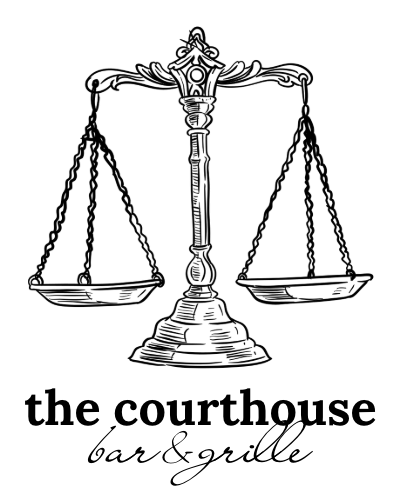
    Let’s start with The Courthouse’s current logo. It’s clear and bold, which makes it feel traditional. The black, while also bold, feels a bit heavy. The justice scales are great for a courthouse theme, but even those feel outdated and “blocky”.

    With a new logo, I wanted to convey the same courthouse theme, but make it feel a little more chic and upscale. If the restaurant is going to be updated, the logo should feel that way too. The justice scale has a more vintage feel, with lots of detail. I kept “The Courthouse” in all lowercase, to make the restaurant still feel casual, but mixed with the calligraphy typeface, feels a little fancier at the same time. I stuck with black and white for the first logo mock-up, but also think dark navy, which is included in the color palette rebrand, could be the primary color used for the logo.

    Moving Forward

    I’m extremely excited to continue documenting this restaurant rebrand, especially because it’s a local business. With an updated brand and more refined feel, the Courthouse is on it’s way to becoming the best restaurant in Putnam.

  • What #BlackoutTuesday Means in 2025

    Shutterstock / Velishchuk Yevhen via Variety

    There’s good and bad in every situation. Social media, for example, has both strengths and weaknesses that add or take away from society in different ways. In this post, I’d like to focus on the good side of social media.

    Activism in the Digital Age

    Where there’s social media, there’s activism. After the pandemic in 2020, many people took to social media to participate in movements like Black Lives Matter and #BlackoutTuesday. On #BlackoutTuesday, millions of people posted black squares in solidarity of ending police brutality and racism, and also added #BLM hashtags. While the intent behind the trend was meant to show support, it backfired and ended up doing the opposite. Many people felt like all they had to do to show their support was post a black square and their participation ended there. It also inundated hashtags and social media with so many black squares, that people couldn’t find real, useful information on how to support black people and ending racism.

    I want to focus on the intention, though. Because I think the meaning behind posting that black square, whether or not it ended up backfiring, is just as important. Posters of the black squares were called out on their laziness and encouraged to do more. It sparked more conversation and countless people on social media, “who would ordinarily never talk about race, apologized and attempted to course-correct. And for them to recognize their own ignorance and do it so publicly is no small thing”.

    The Power of Sparking Conversation

    Social media is powerful, and almost everyone in the world has access to the Internet. It allows us to share information and ideas, learn, and connect with people that we may have never crossed paths with. I’m hopeful that in situations similar to the #BlackoutTuesday movement, that we can continue to learn to do better as a society. Whether good or bad, the movement sparked conversation and encouraged people who wouldn’t ever speak about race to speak about race. It encouraged uncomfortable but necessary conversations, questions, and ideas.

    I posted a black square during the BLM movement, thinking that it was enough. I soon realized though that there was so much more to being an ally than making a single post, and that is how social media can be used for public good. As a white person, I can continue to learn, ask questions, and support the black community, beyond an Instagram post. If others adopt this mindset and realize there is so much more work to do in many areas of social justice, we can use social media for good in ways that would benefit everyone.

  • Promoting on Social Media: Instagram, Facebook, and LinkedIn

    Photo by Tracy Le Blanc on Pexels.com

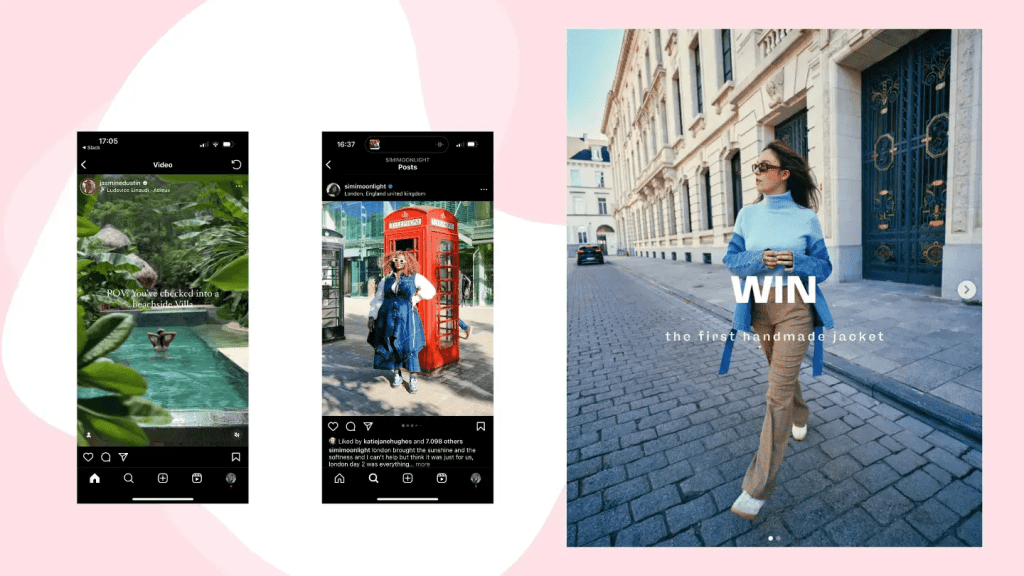
    I’m currently writing an article on the WNBA and the rise of women’s sports. It’s something I’ve always had an interest in—but lately, the industry has been booming. In order to promote my article, I’ve made 3 posts that will go up on social media to encourage sharing, but each post has a different technique as far as copy and graphics.

    Instagram

    For Instagram, I wanted to keep it short and sweet. I chose to use one black and white image (no carousels, because I find that not everyone scrolls through them. I want to catch their attention right away). Everyone knows Caitlin Clark, So I thought the black and white, plus Clark, and the bright orange text might make someone stop. I took inspiration from some of the magazine accounts I follow who post on Instagram with links in their bios leading to the articles. I wanted to give some detail, but keep it “mysterious” to encourage them to click on the link to read.

    Facebook

    I associate Facebook with the older population. It’s not that young people don’t use Facebook, but it seems to be the most-used among older adults. I wanted to create a short post, with a video to capture their attention. The link to the article is located within the post, so the audience doesn’t have to navigate anywhere else to find the article. I thought a video might encourage Facebook users to stop and look. I want the focus to be more on the video and not on the copy. Keep in mind that if this was actually posted on Facebook, the arrow would not be there and the video would automatically start playing should the user hover over this post. (The actual video sample is here, on here, on Canva).

    LinkedIn

    While we associate LinkedIn with professionalism and business, I wanted to mix in a casual tone with my post. I kept the voice mostly sophisticated, but wanted to add a personal touch in saying that I was proud of the work I did on the article. Similar to Facebook, my LinkedIn post had a link to the article directly within the post (Instagram—when are we adding this feature?). The copy in this post was also longer than on Facebook and Instagram, as I’ve found that when users are scrolling through LinkedIn, they’re prepared to read a bit more!

    I’m prepared to actually share my LinkedIn post when my article is completed. Different social media calls for different techniques, and it’s important to lean into each a little differently.

  • Understanding User Personas for Effective Design

    Photo by Ivan Samkov on Pexels.com

    When designing a new item, product, or service, it’s helpful to know who you’re designing for. Not only must you empathize with your target audience, but you should also know their demographics, hobbies, who they’re influenced by, and what their day-to-day looks like. These details are crucial because they keep the important part of design (humans!) at the forefront of the conversation. Now, picture this information neatly wrapped in a little box with a bow. These little boxes are called personas.

    Here’s the fancy definition of personas according to UX Magazine:

    A persona represents a cluster of users who exhibit similar behavioral patterns in their purchasing decisions, use of technology or products, customer service preferences, lifestyle choices, and the like. Behaviors, attitudes, and motivations are common to a “type” regardless of age, gender, education, and other typical demographics. In fact, personas vastly span demographics.

    Companies use personas to help them design for groups of people, rather than make a product for one person with one individual problem. Personas are either made up, or created based on patterns found after conducting research. There’s no “right or wrong” when it comes to personas, and there are a few different versions of them.

    1. Goal-directed personas. These kinds of personas are developed to focus on one thing: what does the user want to achieve with my product? What are some issues that the user might run into? How do we move through these issues? Basically, how can they achieve the goal we want them to achieve, with our product or service?
    2. Role-based personas. Role-based personas are a perfect mix of goal-directed personas and human behavior. They include lots of data and focus on the user’s role in the process.
    3. Engaging personas. Engaging personas take into consideration the emotions of the user, as well as their psychology and behavior. Designers use engaging personas to make them seem more “real” to inspire more ideas.
    4. Fictional personas. Fictional personas are exactly how they sound – fictional. They come from experience, assumptions, and sometimes stereotypes of the people creating them. Many argue that these personas can be flawed because they’re not based on data. Although this may be true, I think fictional personas are the most fun to create and work with.

    This week, after creating a few personas based on my A&F website analysis, I realized how much more difficult I found it to create one around myself, rather than make one up. It took me a while to pinpoint what I thought was worth including and what might be better left out. For some reason, this was probably the most difficult exercise for me in the graduate program thus far, and I’m not exactly sure why. While I appreciate the use of personas, I do know that there are designers who feel that they’re sometimes unnecessary.

    Whatever your opinion is on personas, I believe that they’re useful to get your creative juices flowing. Next time you’re engaged in the design thinking process, give them a try.

    And, if you’d like to take a look at my personas I created for A&F, they’re embedded below.

  • I Gave Up TikTok for 5 Days and This is What Happened

    Do you ever wonder what might happen if you took a break from social media? Would you feel any different? Worse? Better?

    I was inspired to take a break from a social media app for 5 days. At first, I decided I was going to give up Instagram. But after more thought, I had to admit I wasn’t being honest with myself about what would be the most challenging. If I was going to give something up, I wanted it to be worth it. Although I love Instagram (it’s probably my favorite app), it’s not the app I find myself wasting a ton of time on. That app is the one and only… TikTok. There’s something about scrolling TikTok — the endless feed, the quick videos, the ability to pick and choose what you want to watch. I could scroll for hours. And I know plenty of people that feel the same way.

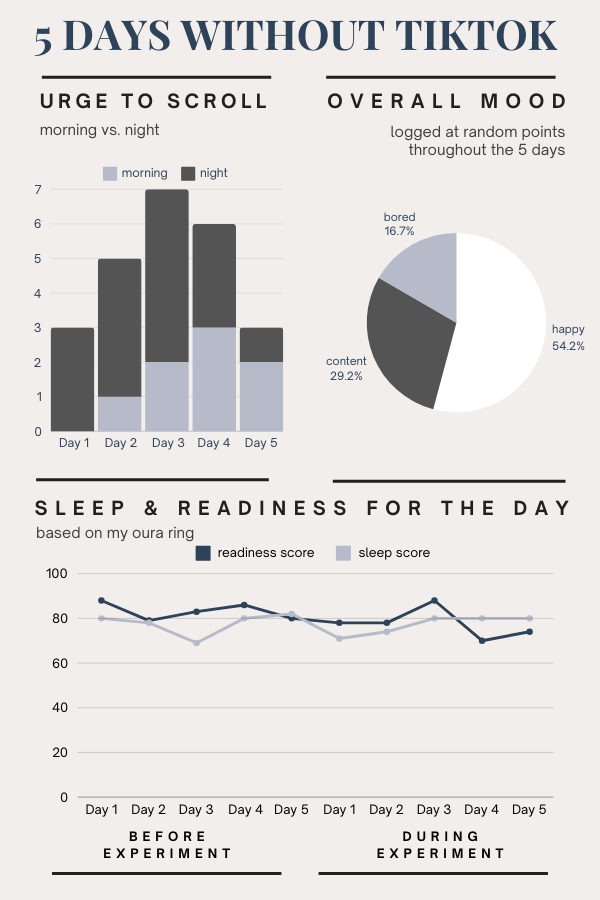
    I collected data on my phone using my notes app, including how many times I had the urge to scroll. I love getting to the end of my day, lying down in bed, and knowing I can just scroll TikTok for as long as I want. The problem is that I will scroll for hours and hours when I should be sleeping. The dopamine-seeker in me doesn’t care about sleep even when the clock strikes 12 am, and I have to be up for 6.

    I also have an Oura Ring which I’ve been wearing for about a year to track my sleep. It’s one of my favorite wellness-related investments I’ve made. It not only tracks sleep, bur also your readiness for the next day, recovery, and workouts. On nights where I’m scrolling for a long time, I don’t get enough sleep and therefore don’t recover well. I recorded all of that data from the 5 days prior and 5 days during my experience. One thing that was most prominent to me as far as my sleep, was that I got to sleep faster when I gave up TikTok. Instead of scrolling, I read my book and would fall asleep within 15 minutes.

    The last piece of data I wanted to record was my overall mood. I felt so much happier after giving up TikTok for a short period of time and paid more attention to the world around me. I was traveling this week and enjoyed people-watching on a much deeper level because I knew I couldn’t look at my phone for entertainment. Another reason that I feel contributed to my happiness was the fact that I didn’t procrastinate. Anytime I had a moment to myself, I didn’t sit and scroll. I knew I needed to get things done, so I did them.

    Below is a visual representation of my week without TikTok. I challenge you to give up the app that you feel steals your time. Take your time back and see how you feel. You might just love it.