Tag: writing

  • Reflecting on Growth: My Final Blog Post in the ICM Program

    Reflecting on Growth: My Final Blog Post in the ICM Program

    Learning Through Women’s Sports

    I’ve learned so much about myself during these last few weeks — and the last year. Over the course of five weeks, I worked on a LinkedIn article series highlighting women’s sports and the inequalities that athletes face. I spent countless hours researching and listening to books, diving deeper into the stories of women who inspire me.

    One of those women is Dawn Staley. While I still haven’t finished her book Uncommon Favor (which I highly recommend), I’ve taken a closer look at her career and leadership style. She’s authentic, vulnerable, and unapologetically real — qualities that have made her a role model to so many. Recently, I even listened to her on Michelle Obama’s podcast, IMO, which I also recommend for anyone who wants to feel empowered.

    Closing a Chapter in My Master’s Program

    As I write this, I feel a weight lifted from my shoulders. This is the last blog post I’ll be writing during my time in the ICM program. Over the past year, I pushed myself to take as many courses as possible in order to finish my master’s degree quickly — and now, looking back, I can see how much my life has shifted during that process.

    I truly owe so much to this program. I’ve learned the importance of strategy, developed skills in content creation, and embraced my creativity more fully than ever before.

    Lessons from My LinkedIn Series

    When it came to my LinkedIn series, the results weren’t exactly what I envisioned. But what I gained was even more valuable: confidence. I’ve become less intimidated about posting on LinkedIn, more comfortable sharing my voice, and better at managing my time.

    I also learned how to document my work effectively, prioritize tasks, and evaluate what needs to be done first versus what can wait. These are skills that will stick with me long after this project.

    Final Results

    Here’s a snapshot of the total performance of my LinkedIn series:

    2,901 impressions | 54 likes | 6 comments | 8 reposts | 21 new followers

    While the numbers tell one part of the story, the growth I experienced throughout this process tells the rest.

    Moving Forward

    This project marks both an ending and a beginning. It’s the close of my time in the ICM program, but also the start of applying everything I’ve learned to the next chapter of my career.

    More details about my project can be found within my portfolio, or linked here.
  • People, Paid Social, and Purpose: Lessons From My Graduate Student Journey

    People, Paid Social, and Purpose: Lessons From My Graduate Student Journey

    I can’t believe a year has gone by since I started the ICM program. I’ve spent countless hours on blog posts, projects, and what has felt like endless research on how to communicate effectively online. I have so much to thank this program for, and here’s a few things I’ve learned.

    1. People first. Companies seem to forget that empathizing with humans is one of the most important things in marketing. It doesn’t matter how well your product works, or how clean your website is. If you aren’t prioritizing the human side of marketing, your brand will easily get lost among the millions of others online. Take the time to understand your audience and prioritize communication with them.
    2. Don’t forget about paid social. I’ve always been a lover of organic social, but in my internship with the Connecticut Sun, I learned so much about the importance of paid social — and I feel like I almost like it more. With the combination of both, you have the ability to build trust with your audience, stay spontaneous, and target new fans.
    3. Typography matters (and so does white space). Surprisingly, one of the things that has stuck with me most is the importance of typography in brands. After learning about the importance of font families, typefaces, and kerning, I feel like I notice it everywhere. I think about why people have chosen the typefaces they do to represent their brand, and what might they want that typeface to convey. I also learned the importance of white space and how it can help you of more ways than one.
    4. Learning never ends. I’ve always loved being a student. I’d gone back and forth about the pros and cons of going back to school after I got my bachelor’s, and the pros heavily outweighed the cons. Throughout this program, while there are some things I’ve noticed stayed the same, the marketing and digital space is constantly changing. I think being open to the ever-evolving world of social media and digital marketing, while continuing to ask questions, is the best way to grow. A long-term life goal of mine is to be a forever student. Ask questions. Stay curious. Keep an open mind.
    5. I finally found my future in women’s sports. I always struggled to figure out where I fit in the professional world. It wasn’t until I landed my internship at the Connecticut Sun (which was ignited by my love of UConn women’s basketball), that I felt like I found my place. I’ve loved sports since I was a kid, and I find celebrating women athletes to be empowering and motivating. I’ve recently been promoted to Marketing Specialist, and I owe so much to this program — having a master’s degree alone is a good way to make people double-take your job application.

    Looking Ahead

    I’ve accomplished so many things in such a short amount of time, that I’m allowing myself to finally take a deep breath in the completion of my degree. It is one of the things I’m most proud of thus far. I can’t wait to see what the future holds.

  • The Dark Side of Being a Woman in Sports

    The Dark Side of Being a Woman in Sports

    This week, I wrote about the issues in safety and abuse among women athletes. In short, the reality is scary. A few months ago, during a Connecticut Sun vs. Indiana Fever game, Jacy Sheldon found herself in a scuffle with Caitlin Clark. The confrontation got heated pretty quickly, and many Caitlin Clark fans went after Jacy Sheldon on social media. I was scrolling through her Instagram comments the next day, and was appalled at the hate and cruelty on her page.

    Social Media’s Role in Amplifying Hate

    I wondered why Instagram wasn’t doing more to regulate the clear hate speech and comments on her profile. At the end of the day, even though she got in an altercation that many people disagreed with, lots of the comments were unrelated, horrible, and just scary. In 2019, Instagram was supposed to role out an AI feature that flagged hate comments before they’re posted. However, I’m unsure if this was ever rolled out, and still — this doesn’t do much to stop the comments from being left.

    When Safety Becomes a Real-Life Concern

    This isn’t the only incident that can take a toll on athletes’ mental health. More often than not, professional women athletes face instances like stalking or threats against their safety. Paige Bueckers and Caitlin Clark are some of the most popular cases because they happened most recently, and they’re both high profile players in the WNBA. Caitlin received sexually violent and creepy messages from a man from Texas named Michael Lewis. He’d text her, saying he was outside her house or outside the practice facility. He now is facing prison time. Caitlin came forward and went to the police, who said “the posts “‘actually caused Caitlin Clark to feel terrorized, frightened, intimidated, or threatened’ and an implicit or explicit threat also was made ‘with the intent to place Caitlin Clark in reasonable fear of sexual battery,’ prosecutors wrote in the Marion County Superior Court filing.”

    Paige Bueckers’ stalker faces charges but isn’t going to prison (why? I don’t know). “Parmalee was arrested by Connecticut State Police on Aug. 27 while he was walking along a highway near Bradley International Airport in Windsor Locks. According to UConn Police, Parmalee told state police that he was going to see Bueckers. Prior to his arrest, Parmalee posted on social media that he was traveling to Connecticut to propose to Bueckers and to get her expelled from UConn.”

    This Problem Isn’t New, and It’s Everywhere

    And as I stated before, these aren’t isolated incidents. Athletes such as Gabby Thomas, Sunisa Lee, Simone Biles, and Coco Guaff have had similar experiences. “This harassment isn’t limited to one sport or professional league. During the 2020 Tokyo Olympics, 87 percent of online abuse targeted women athletes, according to a World Athletics study, and most of the comments were sexual or racist in nature. ‘The levels have gone far beyond what I think anyone would ever have thought,’ tennis player Sloane Stephens, who’s been vocal about online abuse she’s received, told ELLE. “Just how dangerous it is—no one’s really ever speaking about it.” When Stephens lost in the third round of the 2021 US Open, she received over 2,000 messages of abuse. Today, she said she receives around 100 abusive messages after each match, win or lose.”

    At the end of the day, this is bigger than one player, one game, or one moment that fans don’t like. It’s about creating a world where women athletes can compete without worrying about their safety every time they step on the court or open their phones. The reality is that the job shouldn’t come with harassment, stalking, or abuse.

    On LinkedIn

    I tried to touch on this deeper in my LinkedIn article, and am hoping that my professional network will appreciate the insight. I wrote about suggested solutions too, and changes that need to be had to make the world a better place for women. Connect with me here, and stay tuned for the last two articles of my series!

  • Learning (and Posting) As I Go: A Busy Week, My Birthday, and a LinkedIn Lesson

    Learning (and Posting) As I Go: A Busy Week, My Birthday, and a LinkedIn Lesson

    This week was an exceptionally busier week than the last — and I already thought it couldn’t get any busier. It was my birthday, I got a promotion at work, and have really tried to pace myself with my homework. In the past, I’ve found myself saving all of my homework for the weekend or for a Sunday, and am miserable trying to complete everything by the due dates. At work, and through weekly production journals for my class, I’ve found myself become better at pacing my work, and am much less stressed

    A Reminder from my Boss

    The other day, my boss was explaining to me that even though I like to cross everything off my to-do list, I need to get out of that mindset. Likely, my to-do list will never end. It’s more about prioritizing what needs to get done first. And then ask yourself, what could wait until next week?

    Diving Into a New Topic: Gender Pay Gap in Sports

    This week, I wrote about the gender pay gap in sports. This issue has been a well known issue in the world in general for so long, that I feel like maybe it’s just not interesting. For my first article, I wrote a brief history on women’s sports, and below are the metrics:

    Article #1
    Post Date
    : Jul 28, 2025
    Post Publish Time 1:00 PM

    Impressions: 1,005
    Members reached: 588
    Profile viewers from this post: 12
    Followers gained from this post: 0
    Reactions: 16
    Comments: 6
    Reposts: 2

    Here are the metrics for my second article:

    Article #2
    Post Date: Aug 1, 2025
    Post Publish Time: 3:00 PM

    Impressions:171
    Members reached: 88
    Profile viewers from this post: 1
    Followers gained from this post: 0
    Reactions: 3

    Timing is Everything

    After seeing these metrics, it’s safe to say that I will not be posting on a Friday again. Hootsuite published an article that had recommended times for each days of the week, if you wanted to post every day. What’s most important about that article though, is that even if you post at a good time for that day, it might not be the best time in the week. Comparing the metrics from a Monday LinkedIn post to a Friday LinkedIn post showed a drastic change, and I can definitely learn something from my audiences’ behavior. On Monday, people are scrolling LinkedIn more, ready to take on the work week. By Friday, people might not be as active on LinkedIn because they’re ready for the weekend.

    Do I blame them? No. Do I wish my second article performed better? Yes. Admittedly, I don’t know why I would’ve posted at 3:00PM either. That was probably an error on my part, because no article that I have read suggests posting at 3PM on a Friday.

    Knowing Your Audience — and Reaching the Right One

    Another thought I had, was that maybe my article just wasn’t appealing to the followers that I currently have. Women are probably more interested in the topic at hand. The women’s pay gap doesn’t really appeal to men. Over half of my followers/connections are men… so maybe that’s the problem. This week, I’m going to continue working on expanding my followers and connections to women leaders, marketers, and women in the sports industry. I think this will help in appealing to the right audience.

    Lessons I’m Taking Into Next Week

    • Don’t post on Friday afternoons.
    • Keep building a network that reflects the audience I want to reach.
    • Your to-do list will never be empty — so stop treating it like it should be.

    Here’s to another week of growing, learning, and maybe (just maybe) choosing a better time to post.

  • Balancing Game Days and Professional Growth

    Balancing Game Days and Professional Growth

    Finding Rhythm During a Hectic Week

    This week felt like one of the busiest weeks I’ve had in a while. I worked every day, and three of those days were game days, which often take up extra time and energy. No complaints though, I love what I do and am so blessed to work in an industry that I truly love.

    The project management system that I wrote about last week really came in handy. I had an outline and broke down what I needed to get done throughout the week, which it made it much easier to accomplish. It’s hard to even attempt to work on a project that you know will take a lot of thought, when you don’t even know where to start.

    Habit Stacking, Not Multitasking

    Often times, I try to implement habit stacking into my routine, so I can get as much done as possible in the shortest amount of time. I wouldn’t say it’s like multitasking though, because I’m not trying to do too many things at once… just combining tasks I need to get done in a way that makes sense. This week, during my commutes to and from work, I listened to Dawn Staley’s Uncommon Favor: Basketball, North Philly, My Mother, and the Life Lessons I Learned from All Three, which I’m using for research for my LinkedIn project.

    Listening, Learning, and Coach Staley

    I’d always known that Coach Staley was one of a kind — she was the National POY in high school, played on an Olympian team, in the ABL, and the WNBA, and is a pillar in women’s basketball. But, learning about her upbringing has truly been eye-opening. She talks a lot about where she grew up — in the projects in North Philly — and how she had to prove herself to the boys in the neighborhood that she could keep up with them. They’d just ignore her, until she showed them what she could do on the court, and then they started picking her to play the first 10 rounds, which was a big deal.

    Decades later, her impact on the game is felt every day. “Staley is the only individual to win the Naismith Award as both a player and a coach. She is the first Black coach to win three Division I national championships. Bottom line: Staley is a career-long testament to the established excellence and fast-rising popularity of of women’s basketball. Check that, women’s sports. Period.”

    Bringing My First LinkedIn Article to Life

    While getting quite a bit of research and reading time in, I started to write my first article. I wanted to approach the first article and start out as broad as possible, but still throw in tidbits of information that might make people think. I thought about structuring my paragraphs, how to write an effective post to go along with the article, and researched best times to post on LinkedIn. I ended up finishing the article on Friday, but by the time I created the banner for the article, it was Sunday night.

    According to Sprout Social, the best time to post on LinkedIn varies depending on the day of the week. I had thought about posting my article on Sunday night, but I want to give this project the best chance at succeeding. So, my first article is scheduled for 9am on Monday, July 28th.

    By the time you’re reading this, it’s already been posted — and you can find it here. I’d love to hear your thoughts.

  • A Creative Future in Women’s Sports

    A Creative Future in Women’s Sports

    Rooted in Passion

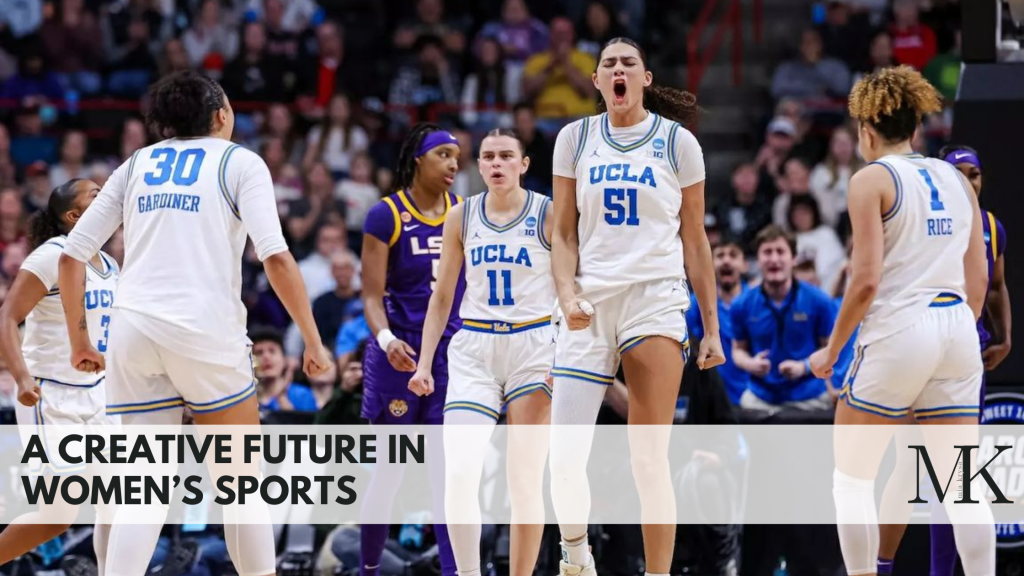
    When I think about my future in the sports world, there’s one thing I’m sure of. As a woman, I want to be an ally for other women and advocate for women athletes in one way or another. Right now, I work as a marketing intern for the Connecticut Sun, and it’s truly my dream internship. My boss trusts in my ideas and in my content, which I think has made me a more confident employee. I love writing, creating graphics, working with paid social (something I never thought I’d say!) and just being creative. Any chance I get to do anything player forward — whether that’s running a meet and greet, crafting a newsletter about what the team has been up to, or helping out a player during media day, I’ll take.

    In my personal life, I love creating content. I love reading, writing, posting on Instagram, traveling, and making TikToks. I’ve always been more creative-minded than anything, so I think working in a position that combines my strengths in creativity and my passion for the WNBA is the perfect role for me.

    Curious About What’s Next

    I’d love to stick with marketing, but I’ve also thought about creating content (player facing). With the Connecticut Sun though, I don’t think that creating content is strategic enough for me. Lately, I’ve been thinking more and more about PR, which I don’t have much experience in, but I have a knack for writing. It’s something I’m hoping to explore before my internship ends.

    I love the days where we travel and have to work games. Being in an environment where I’m seeing an audience cheering for women is inspiring, and I hope it never ends. I feel that I’ve entered the league at the perfect time — it’s exploding and it’s only just the beginning.

    Looking Toward the Bigger Picture

    One day, I could see myself transitioning to a position that spans league-wide, not just for a specific team. Working for the league seems like such a great opportunity to experience athletes, sports media, and sports marketing as a whole. I’ve learned so much from the Sun, and have come to love the team and it’s players, but content always remains focused to one team.

    I’m sitting in front of the TV, watching the 2025 WNBA All-Star game in Indiana, and can’t help but think, “what a wonderful thing to be part of.” No matter what specialty I end up in, whether it’s marketing, content creation, or PR, I know I’ll thrive in a role where I can be creative. I’m blessed to have this opportunity with the Sun, and I can’t wait to see what the future holds for the team.

  • Notion: The Project Management Tool You Can’t Go Without

    Notion: The Project Management Tool You Can’t Go Without

    No, I’m not sponsored by Notion. I just love it.

    What’s Notion?

    If you’re unfamiliar with Notion or other project management tools, you’re missing out. They can be used for anything and everything — especially when it comes to juggling multiple projects at once, which is exactly what I’m doing right now. With Notion, you can create templates to make to-do lists, calendar appointments, track deadlines, or even do fun things, like cross things off your bucket list. It’s completely customizable, has clean UX/UI, and makes the user feel accomplished when they cross something off their list. I’ve even know people who’ve made templates to track what books they’ve read, how they rated them, and any more information they wanted to include in one sheet. The possibilities are endless.

    Using Notion to Organize my LinkedIn Project

    In this instance, I’m using Notion to organize my LinkedIn project for the next six weeks. Each week, I’ll be writing an article on LinkedIn, discussing different gaps and inequalities in women’s sports vs. men’s sports. Since I want to work in sports media and stay in the WNBA world, it’s important that I become a thought leader in the industry, and this is one of the ways I can do that.

    I organized each week like the photo above, and included due dates, status updates, and tags, so I could keep track of each assignment. In each task, users have the ability to expand and create another template. For mine, I chose to list smaller tasks that I could cross off throughout the week. At the end of each week, my subtasks should look like this:

    I plan on checking into Notion each day to stay on top of my studies. Plus — this is one class, and I’m also completing my master’s capstone at the same time. It’s safe to say that my plate is full.

    This week, I also annotated my bibliography with the current sources I have. I plan on starting to write my first article as well, just because this class happens in such a short period of time, I’d like to get ahead of schedule. I love to write, so this isn’t an issue for me. For this project, I picked something that I genuinely enjoy, but also in an area where I know I have some work to do (my LinkedIn presence), and establishing leadership.

    Updating my Profile

    This past week on LinkedIn, I tried updating my profile to the best of my ability. In one of the videos I cited in my bibliography, Tommy Clark spoke about how important it is to have a clean, concise, and clear presence. In other words, who are you, and what problem are you solving? Why should someone in your target audience follow you on LinkedIn? You don’t have to have a long bio, or try to answer multiple questions at once. Keep it simple. If I’m going to post an article each week on LinkedIn, and I want people to engage with my profile and my posts, my profile has to look top-tier. I updated my profile picture, bio, and headline. I’m starting this experiment with 265 connections, and I’m hoping to reach at least 100 more.

    Stay tuned for my first article next week! Connect with me here.

  • Women’s Sports, LinkedIn, and What I’m Doing About It

    Women’s Sports, LinkedIn, and What I’m Doing About It

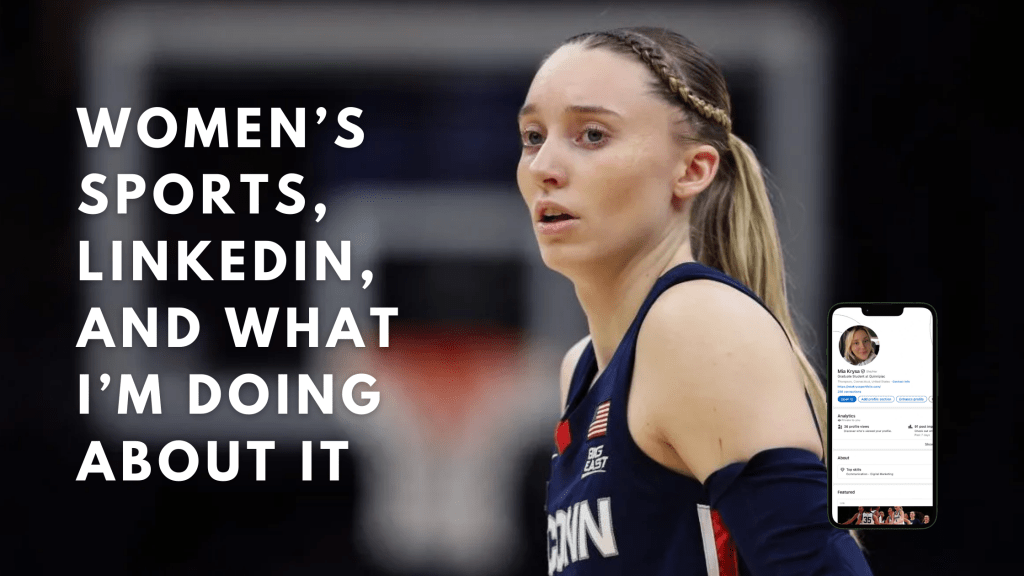
    In the culmination of my graduate degree, I’ve been thinking about what career I want to pursue and where I think I can do better as far as my online presence. I know one thing without a doubt — I want to work in women’s sports. In February, I accepted an internship with the Connecticut Sun, and it’s been such an amazing learning experience for me. Not only did I finally figure out where I fit in the professional world, but also what I’m genuinely passionate about. As a woman, I love seeing other women succeed, and as a life-long lover of most sports, I love seeing women succeed as athletes. I’ve learned so much in my internship and continue to learn more every day, about things like paid social, email marketing, app management, writing copy, creating promotional graphics, working with brand partners, ticket sales, and more.

    But why is any of this important?

    It’s important because we’re doing it for a women’s sports team. And historically, women’s sports has been neglected and ignored in almost every aspect of society — until now. The WNBA, for example, is finally getting the recognition it deserves, and has reached a new high in viewership this year. “The WNBA kicked off its 2025 season with unprecedented viewership numbers, setting new records for opening weekend on ESPN platforms. The marquee matchup between the Chicago Sky and Indiana Fever became the most-watched WNBA game ever on ESPN, drawing an average of 2.7 million viewers and peaking at 3.1 million. This marks a 115% increase over last year’s regular season ABC average.” But make no mistake — there’s still a long way to go.

    My Lacking LinkedIn Presence

    Personally, I struggle with LinkedIn. I don’t know if it just feels too formal to me, or if I’m not connecting and following with the right people. I think I’ve always felt some sort of imposter syndrome, which is when someone thinks they’re “undeserving of their achievements and the high esteem in which they are, in fact, generally held.” I’m familiar with this feeling, especially because it’s easy to compare yourself to other people in your 20s. I’m in a place right now where I feel like I could be farther in my career, but I’m really just starting, and I struggle with that sometimes.

    Because of my imposter syndrome, I’m not as confident with posting on LinkedIn as I should be. But I’m here to change that. Combining my professional interests, and my lack of presence on LinkedIn, plus my passion for protecting and recognizing women in sports — I’ll be releasing a 6-week LinkedIn series, educating others on the history of women’s sports, the gaps between women and men in multiple areas, and how we can move forward.

    A Game Plan for Change

    Look out for my LinkedIn articles! I’ll post one article and one post per week, focusing on a different aspect of women’s sports. They’ll be about 600-1,000 words long, and backed by thoughtful research from articles, journals, podcasts, books, and videos. The goal is to not only educate others on historic and societal barriers that women athletes face, but to establish myself as a thought-leader on LinkedIn. This series will aim to reach audiences
    who want to create change — from athletic directors to sports executives and everyone in between.

    Connect with me here.

  • From Fangirl to Feeds: Growing up with Social Media

    From Fangirl to Feeds: Growing up with Social Media

    The Early Days of the Internet

    When I think about the way that social media has changed over the years, it baffles me. I was born in 1999, the same year of the Internet. I grew up without much social media, and iPhones didn’t come out until I was 8 years old. Back then, I remember iPhones being considered some kind of luxury.

    I remember social media really becoming popular around 2013, when I was in 8th grade. At this time, I was obsessed with the boy band One Direction. I’d spend my days on Twitter and YouTube, watching music videos of the band, following their journey, and tweeting about them with other young girls who had the same interests. At that time, many people said that One Direction surpassed the popularity of the Beatles, which sounded like a crazy statement at the time. Looking back, they were exactly right, and that was because of social media.

    One Direction and their Online Community

    “One Direction had a recruitment and promotional technique that no boy band before had ever utilized properly: the internet” (Greenwood, 2020). CDs turned into Spotify. Newspapers turned into Twitter threads. Traditional publicists turned into fan accounts with thousands of followers. Social media connected the distance between celebrities and fans in a way that was never possible before. One Direction’s popularity wasn’t just about their music — it was about how easily their music could be shared. Fans from all around the world could tune in. It also felt like they had a personal stake in the band’s success because they were part of the online community that kept the hype alive.

    In 2013, there were no algorithms manipulating our feeds, no influencer marketing, no brands trying to sneak into our conversations. Social media felt new, simple, and much less commercialized. As I’ve gotten older, and continue to use social media daily, I’ve noticed a shift. Social media platforms today feel more like digital malls than gathering spaces. Content is now designed for virality rather than authenticity. The same tools that helped build global communities around a band like One Direction are now used to sell products and even used to spread misinformation. Instead of social media being a fun place to go, it can sometimes feel overwhelming and saturated.

    Nostalgia for the old Social Media

    Still, I can’t help but feel nostalgic. Social media introduced me to people I would’ve never met in real life. It gave me a voice at a young age, and put me in touch with other girls who had the same interests. I often wonder if today’s teens feel the same way. The Internet has grown up and so have I, but I’ll always reminisce on the times I used it to support a boyband from the UK.

  • Mood Boards, Marketing, and Manifestation

    Photo: Canva

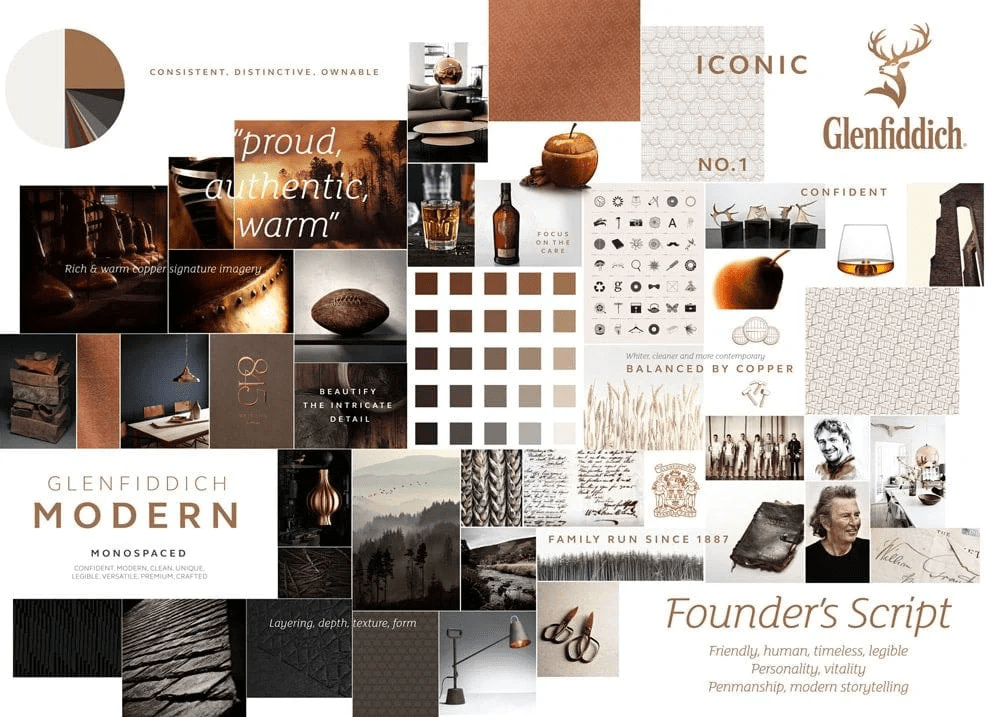
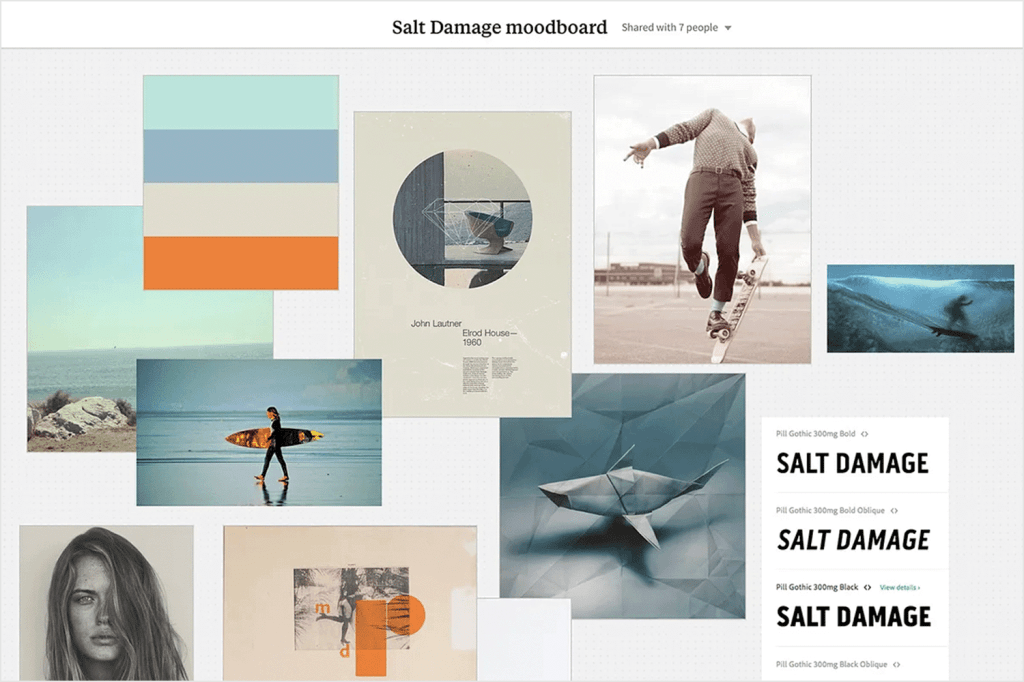
    I’m a much more creative person than analytical, and making mood boards has always been one of the most fun and expressive ways to explore different colors, textures, and “vibes.” Mood boards are like modern scrapbooks (which I also love)—they help tell a story or communicate a feeling without needing any words. Pinterest is basically a giant mood board in itself and one of my favorite platforms for curating visual inspiration.

    Mood Boards in UX Design

    Now that I’m almost done with grad school, I’ve had the opportunity to learn about mood boards in a more strategic way—especially when it comes to UX design. A mood board is essentially a collage of images, video frames, patterns, or text that convey a certain feeling at a glance. They’re most often used in branding, fashion, interior design, cinema, or even in non-visual fields—like fragrance—to convey a certain feeling or message.

    In UX, mood boards help visually align the team on the emotional tone or aesthetic direction of a digital product. For example, if you’re designing a travel website, you might use images of sandy beaches, cozy mountain cabins, airplane windows, friendly typography, and warm, inviting colors. Each element contributes to a collective feeling—adventure, comfort, escape, excitement.

    As you’re adding items to your mood board, try to strive for unity. You want everything to convey that specific feeling your searching for, and to compliment each other in different ways. You’ll also want to prioritize a hierarchy of items when making your mood board. Make the more important elements larger, and less important elements smaller.

    Mood Boards in Marketing

    Mood boards are huge in marketing. They’re often used early in a campaign to help define the brand tone, messaging, and visual style. Before a single social media post is written or a video is filmed, creative teams will often build out mood boards to make sure everyone is on the same page.

    Think of a campaign for a sustainable clothing brand. The mood board might include earthy tones, soft textures like linen or cotton, serene nature scenes, and clean, minimal typography. That mood board then informs everything from the website layout to the social ads to the packaging.

    Photo: JustInMind

    Mood Boards in Your Life

    I’m an avid mood board creator (as you may have picked up on at the beginning). I use Pinterest to make different mood boards—also known as Boards on the platform—to envision the exact vibe or goal I want to manifest. At the beginning of every year, I usually create a new board and start pinning photos, quotes, colors, and visuals that align with what I want that year to look like.

    I’ve also created mood boards for more specific events—party planning, trips, home decor, you name it. They’re not just for professionals or designers—they’re for anyone who wants to create with intention. Whether you’re visualizing your dream apartment or brainstorming a brand identity, mood boards are a great way to bring an idea to fruition.

  • Remember Kony 2012? Me either.

    Source: NY Times

    Kony 2012, as you probably remember, was a video created in 2012 to shed light on the horrible things happening in Africa — Joseph Kony, a cult leader and war criminal, was head of the Lord’s Resistance Army, who abducted children and forced them to become soldiers. The video showed graphic and disturbing content, and followed Jacob, an African child who lived his life in fear of being abducted by the LRA. It was heavy, emotional, and garnered millions of views in a short period of time.

    The Viral Video That Shook the World

    In 2012, I was in 6th or 7th grade, and watched Kony 2012 for the first time with a few classmates. I felt sad for the children in Africa, who were the same age as me, but living completely different lives than my classmates and I. They woke up every day and lived in fear of becoming child soldiers, while my biggest problem every day was probably what I was going to wear to school. Kony 2012 ignited something in my classmates and I where we felt like we had to participate to spread awareness, and we headed down to the computer lab to print posters of Joseph Kony to hang around the school. One of the main goals of the video was to make Kony a household name, so everyone would know who he was, which would hopefully incite more change.

    That’s all I can remember about my participation in raising awareness for Kony 2012. And I think many other people felt the same way. Besides sharing the video, purchasing kits that contained bracelets (among other things), and hanging posters, there really wasn’t anything tangible to do that would guarantee change. I quickly forgot about Kony 2012, and had not thought about it again until this week.

    Lessons in Virality and Digital Activism

    Watching it over this week, I still felt sad for the children in Africa. But I thought, “they had to have captured Joseph Kony by now, right?” Wrong. Joseph Kony is still hiding out somewhere in Africa. While Kony 2012 captured the attention of millions of people, it didn’t create the long-lasting change they’d hoped for. Nonetheless, it taught us how powerful social media can be in creating change.

    Kony 2012 “taught others how to harness the power of the web for good—and how to do it responsibly.” It showed how powerful the internet can be, and that it is possible to create a campaign that goes viral. But you have to do it correctly. In 2025, we have the opportunity to learn from Kony 2012, and do something different.

  • The Subtle Influence of Typefaces on Memory and Branding

    via PicMonkey

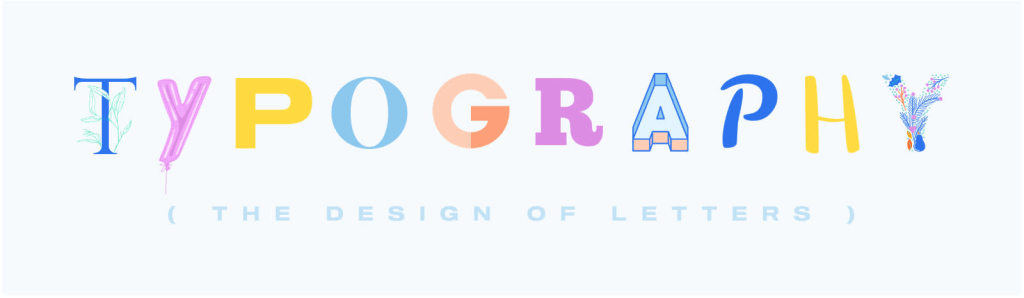
    I had never really given much thought to typefaces until this week. It wasn’t something I paid much attention to. But after being introduced to the world of typefaces, fonts, and everything in between, I realized how much they play a role in brand identity.

    Discovering the Power of Typefaces

    Some typefaces are instantly recognizable. While scrolling through typefaces online, I came across one that felt extremely nostalgic. If you grew up in the early 2000s, you are probably familiar with the children’s book, Don’t Let the Pigeon Drive the Bus! by Mo Willems. The cover’s iconic typeface is seared into my memory. The moment I saw it, I felt 5 years old again. I hadn’t thought about that book in years, but with just one glance at the typeface, I could picture the cover perfectly. That’s when I realized how powerful typefaces really are.

    The Cover of Don’t Let the Pigeon Drive the Bus! | Source: Mo Willems

    Typefaces have a unique way of shaping how we interpret content or a brand. For example, think about the Harry Potter series, which is another nostalgic brand for me. The recognizable lightning-bolt-inspired typeface used for the book titles and movies is now synonymous with the franchise. Without even seeing what something says, most people would immediately associate the typeface with the franchise. It’s a perfect example of how typefaces become deeply tied to a brand or cultural phenomenon.

    Typefaces vs. Fonts

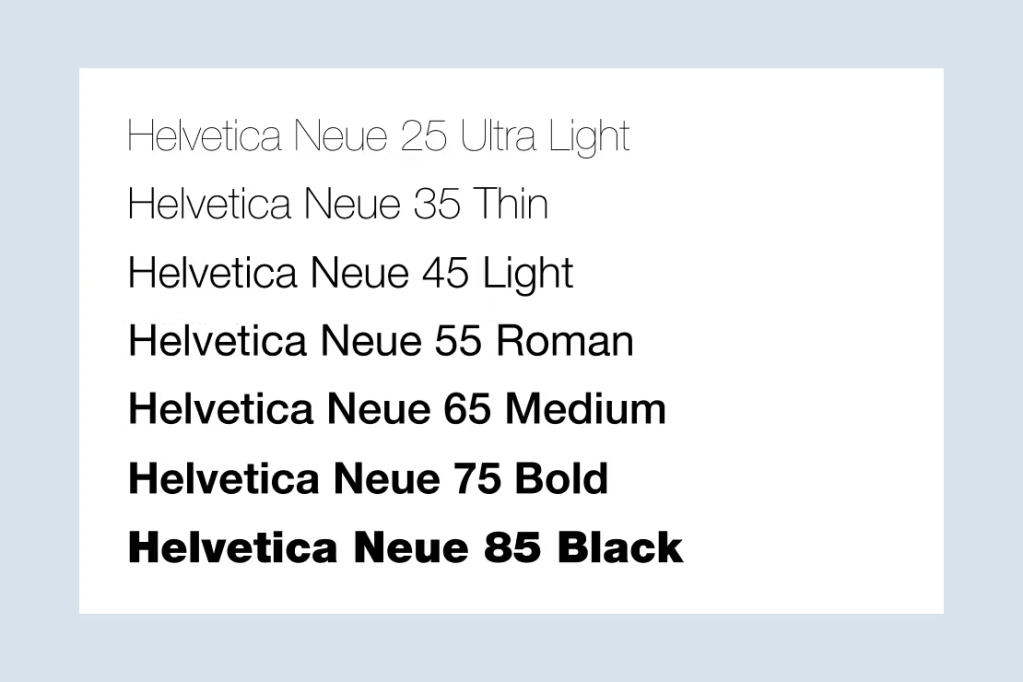
    Up until this week, I had always used the word font to describe what I now know is a typeface. Turns out, there’s actually a difference. A typeface refers to a font or font family with various widths and weights, but same overall style. A font, on the other hand, is the style of the typeface within that family. In the image below, the typeface is Helvetica Neue, while the fonts are all of the variations —like Helvetica Neue 25 Ultra Light is a font, the same way Helvetica Neue 85 Black is a font. Make sense?

    Source: Wix

    It’s interesting how something as subtle as typeface can evoke such strong emotion and memories, all while playing a role in shaping how we perceive brands. “Well-chosen typography can enhance the brand’s image, making it more memorable in the minds of its target consumers.” When you think about some of the most memorable typefaces, you might think of the Nike typeface, Futura Bold Condensed. It’s bold, energetic, and strong. Or, you might think of writing a paper in APA format and making sure the typeface is Times New Roman, which is slightly decorative and easy to read. Different fonts convey different meanings, and each one is unique.

    Typefaces = Brand Identity

    I never thought I’d care much about typefaces, but now I can’t stop noticing them. They’re everywhere — on book covers, logos, websites — and they’re important to a brand’s identity. Whether they spark nostalgia or make a brand instantly recognizable, typefaces have a subtle yet powerful influence. They’re a reminder that even the smallest details make a difference in brand story and identity.

  • Redesigning Goodreads: A UX Research Case Study

    Photo by Startup Stock Photos on Pexels.com

    Goodreads is a well-known book-tracking platform for book lovers. It’s the most popular platform of its kind and serves as a place for organizing, book reviews, recommendations, and more. Despite its popularity, many users find it cluttered, unorganized, and hard to navigate. This case study explores the research conducted in evaluating Goodreads’ strengths and weaknesses to suggest a more user-friendly design. 

    At First Glance 

    The first step in the site evaluation process was simply to evaluate. It was important to take note of common issues and research the problems that users were having on a day-to-day basis. Upon immediate inspection, the website felt cluttered and disorganized and had an overwhelming navigation center. There were irrelevant pop-up ads and glitches with the reading challenge, a popular feature that many users like to participate in. Goodreads and its competitors were also researched in this step. Even though Goodreads is the most popular, it lacks up-to-date features that platforms like StoryGraph use: the ability to make ½ star ratings and book recommendations based on your mood, to name a few. 

    From the User’s Perspective

    Next, personas were created to imagine the different kinds of users that use Goodreads. Also, interviews and surveys were made to learn what users liked and disliked about Goodreads. Most often, users liked the book-tracking and organizational features but disliked its outdated design and lack of personalized recommendations. 

    Along with the interviews and surveys, a card-sorting test was conducted to help re-work the navigation center. Many of the pages listed in the Goodreads navigation center were repetitive, unclear, and just didn’t make sense. Users were given the freedom to sort the pages in categories where they saw fit, and patterns were recorded to then come up with a navigation center that would make sense to most people. 

    Photo by Pavel Danilyuk on Pexels.com

    Goodreads’ Usability 

    While the website seems like it’d be easy to navigate, a heuristic evaluation showed the opposite. The site is over-complicated, and the navigation center continues to disappoint. A usability test was also conducted, and results showed that users who were familiar with Goodreads had learned to navigate around the flaws, whereas users who weren’t so familiar with the platform struggled altogether. 

    Suggestions for Goodreads 

    After this 6-week evaluation, some suggestions are definitely in order. 

    • Goodreads needs a dedicated “Trending Now” section, instead of plopping new books on all kinds of pages, with no theme or organization 
    • Incorporate AI into their recommendations like other platforms to give a more personalized feel
    • Reduce ads (or completely get rid of them!) as they’re messy and distracting 
    • Put more time and effort into the back-end of the platform to reduce issues that users are experiencing with website glitches and their devices not syncing 
    • Review filtering should be improved so users can filter through the kinds of reviews they want to see and add a ½ star option for more accurate ratings 
    • Market less towards authors and more towards readers 
    • Combine pages where seen fit. There are too many pages that repeat the same information in a different way 
    • Friend activity tracking should be more accessible and designed less like a social media feed 
    • Updated design for a modern, cleaner feel 
    via Goodreads

    Conclusion 

    This project combined various UX research methods to suggest a complete website redesign of Goodreads. In the end, what matters most is that Goodreads prioritizes its readers. Users want to feel seen, heard, and listened to, and Goodreads is not doing that. With a better design, condensed navigation, and more updated and personalized features, it could become a platform that readers truly enjoy. 

    Below is the final report.

  • The Audiobook Dilemma: Habit-Stacking, Retention, and the Future of Reading

    Photo by Ivo Rainha on Pexels.com

    I set a reading goal for the beginning of 2024 to read 52 books. I underestimated how hard it was going to be for me to stick to my goal. I’m ashamed to say that I’m now at about 9 books completed for this year. I’m so disappointed and have found myself scrambling to finish as many books as possible before the new year in attempt to make myself feel better.

    The problem is that I’ve found it hard to find books that hold my attention. I’ll start a book and make it a quarter of the way through (sometimes even half!) and I just get bored, and won’t finish it. After contemplating why I tend to do this, I think another reason was probably that I don’t have enough time. And I hate that excuse. But here’s what I’ve done to overcome that.

    Habit-Stacking to my advantage

    I came across this new thing called habit-stacking. It’s where you stack a few things you need to get done—and do them at the same time— to be as efficient as possible. In my case, I started listening to audiobooks while I was driving, cleaning, cooking, showering — you name it. I thought I could try to finish as many books as possible, while doing the things I’d already be doing.

    Writing for the ear

    I came across an article about writing for the ear. “When you are writing for print, ideas and stories are communicated in a visual-linear mode which engages logic and thought. The kind of writing you do for a listener is quite different than when writing for readers. When writing for the ear, follow the ABCs. Accurate. Brief. Clear.” (Swenson, 2017).

    This got me thinking if I was even absorbing any of the information I was listening to, rather than if I’d actually read it. Audiobooks aren’t necessarily written for the ear. Books are written to be psychically read, while cozied up on the couch. While I feel like I’m doing the right thing by listening to as many books as I can to read my goal, is it worth it if I don’t even retain the information?

    I wonder if at one point in the future, books will be written to be listened to. Podcasts are formatted to be listened to, as well as radio shows and news broadcasts. Will authors ever decide to write book in an audiobook format? Will it change the way we read? With AI on the rise, I’m curious to know what the future of books will look like.

    References

    Arnold, A. (2017, October 24). Writing for the Ear Instead of the Eye. Swenson Book Development. https://swensonbookdevelopment.com/blog/2017/writing-for-the-ear-instead-of-the-eye/

  • Lessons from Ms. Williams

    Photo by lil artsy on Pexels.com

    After beginning On Writing Well, by William Zinsser, I started reflecting on my life as someone who’s always considered herself a writer. My earliest memories involve me having some kind of journal, where I’d write about my days at school and talk about memorable moments that I wanted to remember. As time passed, these moments ranged from concerts, holidays, vacations, the birth of my sister (my favorite—I was 12, and it was on Easter that year), graduations, breakups, and everything in between.

    Over the years, I began adding pictures into my journals. I’d print them from my phone, take Polaroids, and kept receipts or other memorabilia to glue into the pages. Some of my favorite pages to look back on are where I kept to-do lists. I’m able to look back on not only what I was thinking about that day, but what I had to do. My to-do lists from high school are vastly different from my to-do lists now. I love being able to see the natural progression of my own life.

    In high school, I enjoyed writing essays and English assignments. My school was very small, with not many teachers, so I had the same English teacher my freshman and senior year—Ms. Williams. She was always serious and came off a bit cold at times, but you could tell that there was warmth beneath the surface. I think I’d only seen her laugh a handful of times. She cared about what she taught and it showed.

    Ms. Williams ingrained a few rules about writing in my brain that I will probably never forget. We could never use first person in our writing. It felt so freeing anytime I’d had an assignment where first person was allowed. She taught us how to structure a thesis at the end of an introduction, and we had to follow this format no matter what:

    One can see why/how this argument is true (for example) by analyzing xyz.”

    That used to frustrate me. One? Who is that? In On Writing Well, Zinsser, he states, “I don’t want to meet “one”—he’s a boring guy.” She also hated when we used the word “it” as she felt it was unclear. For example:

    Ms. Williams was also the only teacher to give me a detention for going to the beach on senior skip day. On Writing Well has me questioning rules about writing that I believed to be true. I’ve never read a book about writing, so maybe his opinions aren’t necessarily unique, but they’re new to me. I’m excited to continue reading this book and learning more about writing to become a better writer. So far, I’ve learned that it doesn’t have to be that serious. Write for you, not an imaginary audience. I’m thankful I have years of journals to look back on and know I’ve improved as a writer since my middle school journals, maybe thanks to Ms. Williams.

  • Writing for Today’s Society

    Photo by Pixabay on Pexels.com

    Writing has always been something I enjoyed. And I always felt like it came easy to me. I was never intimidated by essays or assignments where lots of writing was expected. The assignments I dreaded most were ones that involved math or science.

    I’ve never thought about how I write or why I write. I just write. And to ponder all of the logistics that come with writing online is a new feeling for me. I was thinking about “readability” and what makes one thing easier to read than others. It’s not just about the text– it’s about how the text looks on the screen and other elements, like photos, that draw in the reader.

    What makes online text easier to read?

    Anyone can write. But writing well is what makes you stand out. This day in age, everyone is moving fast. We all have things to do and places to be, and we rarely stop to read anymore. Less and less people can focus long enough to get through an article or read a chapter of a book. More of us are prone to scanning, where we scroll quickly and try to pick out the important pieces. It’s gotten to a point where we have to tailor the way we write to make the content more digestible.

    The Basics of Writing Well Online

    A few things I learned to keep in mind are below:

    1. Spacing between paragraphs is helpful to not overwhelm the reader.
    2. Bullets, lists, or numbers are great for skimming.
    3. Minimize the amount of words you use to keep readers engaged.
    4. Subheaders!
    5. Make sure your font is large enough.
    6. Use pictures throughout.
    7. The larger and cleaner the margin, the better (for the most part).

    Moving Forward

    As someone who writes for fun, and posts her work online, these are all important things that I never really considered in my own work. It’s an aspiration of mine to be someone who writes well. One day, I hope to write a book (maybe a memoir?), but for now, I think it’s important to know how to write online. When society is chronically online, it’s a crucial skill to have.

  • Effective Ideation Techniques to Spark Creativity

    Photo by Pixabay on Pexels.com

    Have you ever tried to come up with something new— an idea, design, or opportunity— to feel like you keep drawing blanks? Like your brain simply isn’t doing what it needs to do? No matter how hard you try, you just feel stuck? It’s not just you. Most of us have faced this situation once or twice. Here are some ideation techniques to help spark new ideas, or at the least, get some wheels turning so you can start making progress.

    What is Ideation?

    According to Interactive Design Foundation, ideation is at the heart of the design thinking process. There are literally hundreds of ideation techniques, such as brainstorming, brain-dumping, sketching, SCAMPER, and prototyping. Ideation involves taking ideas from your conscious and subconscious mind, to come up with the best solution. In other words, let your mind run wild! Let’s discuss a few techniques in detail.

    Brainstorming

    Brainstorming is probably the most common ideation technique. I can think back to my early school years and remember my teachers introducing this concept. In my eyes, I’ve always just thought of it as a fancy term for bouncing ideas around (by yourself or with others), to come up with a solution. During a brainstorm, you should be able to share ideas without fear of judgement.

    Sketching

    Sketching is a great way to bring ideas to life. Visuals sometimes help come up with new ideas a bit better than words do. Your sketches don’t have to be pretty, or well-thought out. It’s actually better if they’re messier and rough, as it leaves room for further development and improvement. Sketches are also great for sharing ideas with others.

    Analogies

    Using analogies to spark new ideas is exactly what it sounds like. The idea is to come up with similar situations or concepts, and build off of ideas that pop up. To me, using analogies sounded a bit weird and like it could be considered copying, but some designers believe that “all design is re-design.”

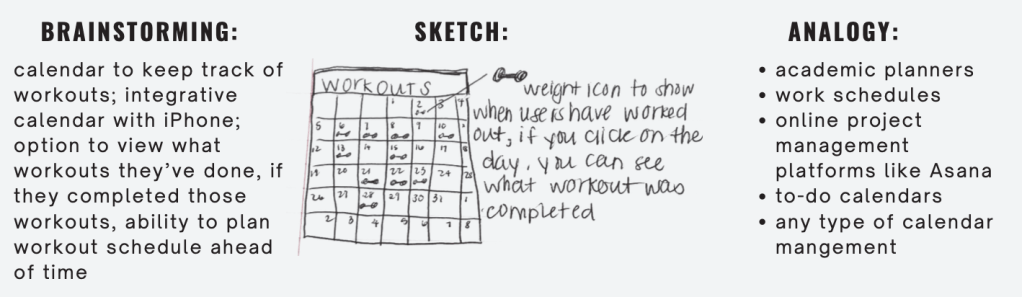
    Ideation on Nike Training Club App

    I wanted to see the above techniques in action, and decided to use them to come up with new ideas for a few different workout apps. I analyzed and compared three different workout apps and created two POV statements for each, after I collected enough data on user experiences. Then, I brainstormed, sketched, and analyzed each POV statement to try to come up with an idea to solve each statement.

    The Nike Training app for example, had some issues with users feeling like it wasn’t beginner friendly. Users also wanted a way to track their previous workouts in a calendar form to stay organized and even plan future workouts.

    POV Statement: Users who like to plan their workouts need a calendar feature to view their history and future workouts because there’s no way to see what they’ve completed, or the ability to track progress.

    And here were my 3 different ideation techniques in action:

    Notice how they differ? And how each technique comes up with different ideas? Off of one POV statement, I was able to build 5+ new ideas using just three techniques.

    Try some of these new techniques if you’re feeling stuck, and I can almost guarantee that you’ll come up with something new. If you’d like to look more into my presentation on ideation techniques on my POV statements from last week, see below.

  • The Importance of POV the in Design Process

    Photo by Maksim Goncharenok on Pexels.com

    A crucial part of the design process involves understanding the user’s point of view. Up until this point, I’ve covered empathy pretty deeply — but wanted to touch on POV and problem statements in design.

    What’s a problem statement and why are they important?

    A problem statement is sometimes thought of as the most challenging part of the design process. It forces designers to either come up with a problem statement to solve or focus on a problem statement that’s already been brought to their attention. When you have a clear statement that guides you in the direction of brainstorming solutions, it makes the design process more clear and helps you to stay focused. When you have a clear objective, you’re much more likely to stay on track.

    Problem statements aren’t just random words strung together. They have to be well thought-out. There are a few qualities that a successful problem statement should have, according to Interaction Design Foundation. These qualities are to be:

    1. Human-Focused. Have you noticed a theme in design thus far? Hint: the user comes first. 😆
    2. Broad enough to allow creativity. Don’t get stuck in a box! Your statement needs to be focused with room for flow and creativity.
    3. Narrow enough to stay organized. I know, it’s a bit of a juxtaposition. Just don’t go overboard. Keep it simple and to the point.

    Where does POV come in?

    A point of view (POV) is a meaningful and actionable problem statement which will allow you to ideate in a goal-oriented manner.

    Empathize with the user, know what they need, and why they need it. Take this information and structure it in a sentence like this:

    [User . . . (descriptive)] needs [need . . . (verb)] because [insight. . . (compelling)]

    There you have it! Your POV. I’ll show you an example.

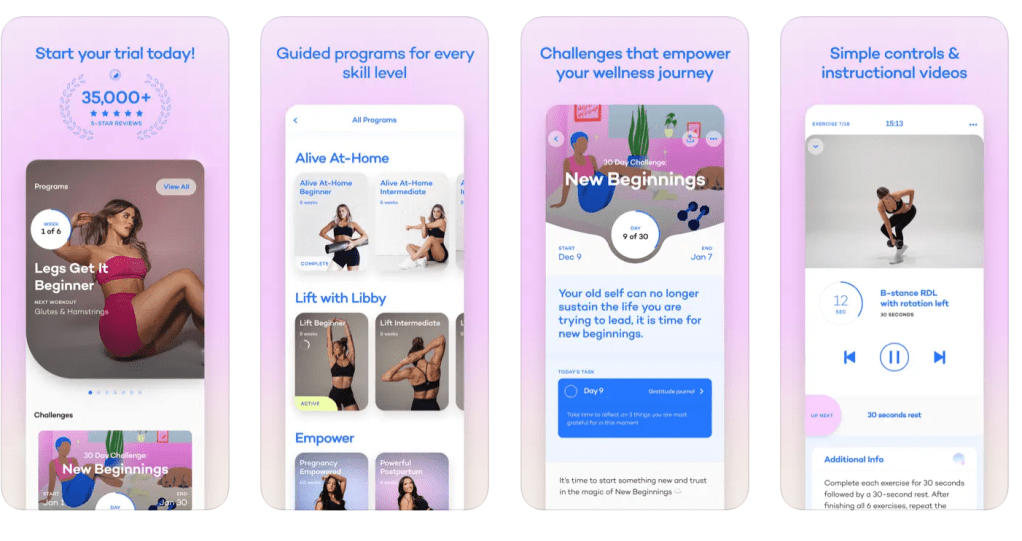
    App POVs: Alive by Whitney Simmons

    I decided to take a look at a few workout apps, analyze reviews and collect data, then compare their problems to each other. After I got an idea of what worked/didn’t work for each app and what could be improved, I created a POV statement to reflect the user’s needs. One of the three apps I looked at was Alive by Whitney Simmons. I’m a frequent user of this app, and while I’ve had a great experience, it was interesting to see how other users were interacting with the product.

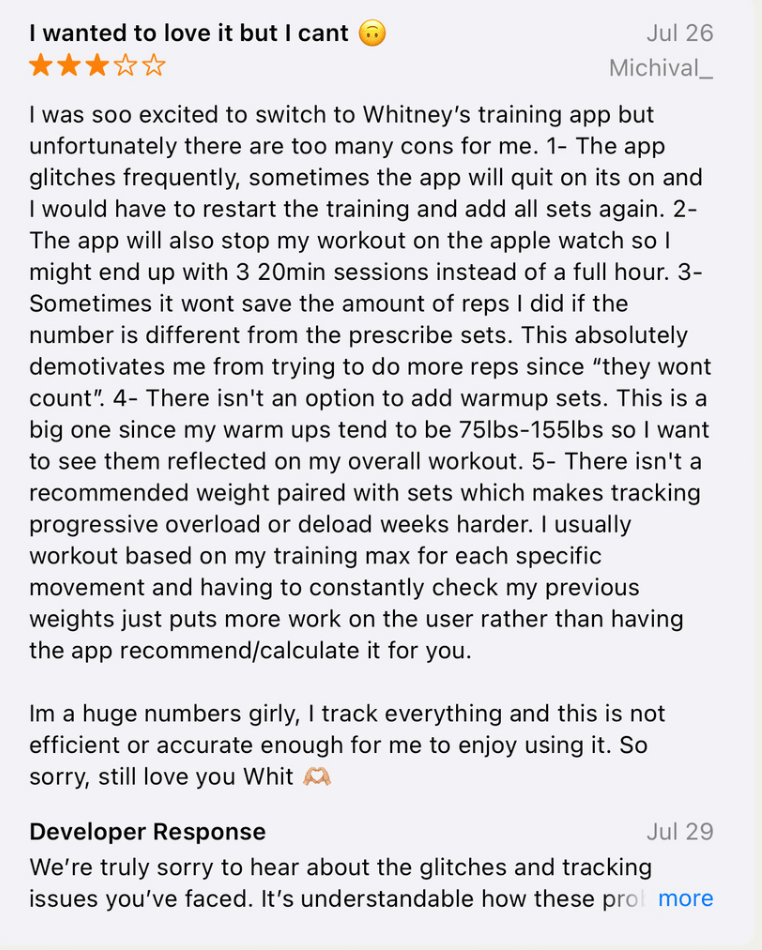
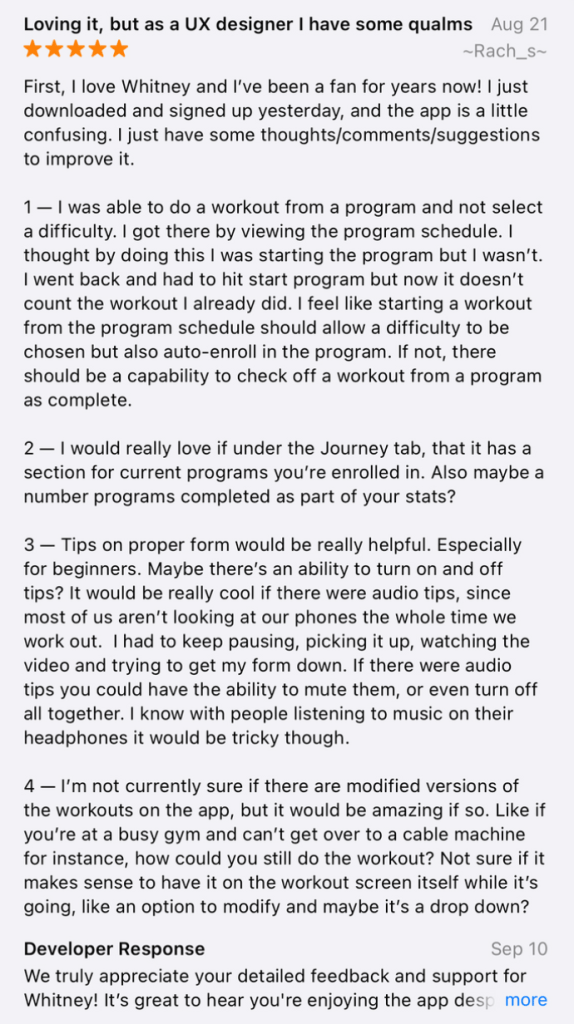
    The app is rated 4.9/5 stars on the Apple App Store. It’s a workout app that provides different programs from ones at home to ones at the gym (all for different experience levels). Most users have had a positive experience, but there were also some that hadn’t. There were other users who provided helpful feedback and suggestions to improve the app itself. Here’s some of what they had to say:

    In summary, most users loved the app but had ideas to add a nutrition element, a way to keep track of weights/reps, tips on workout form, and more. I took this information and developed two POV statements using the sentence template I talked about before.

    Users who like to track their reps and their weights need a feature that automatically recommends or calculates the last weight used because it’s inconvenient to have to look elsewhere or remember what you may have lifted last.

    Users who want to track their calories and/or macros need a nutrition element within the app because it’s frustrating to use other apps to track food. If everything was in one place, it would be easier and more worth the money.

    The problem statements above reflect what’s important to the user and provides insight on what could be improved. It’s a clear statement that shows the designer what to work on, but allows creative freedom and room for different ideas that would solve the problem.

    I analyzed two other workout apps in comparison to Alive; Nike Training Club and Peloton. If you’d like to dive into POV in the design process a bit more, find my presentation below.

  • The Struggle to Focus in a Distracted World

    As I’ve continued reading Stolen Focus, I’ve begun to think more about ADHD, anxiety, stress, and the internet. Quite a handful, I know. Hari, the author of Stolen Focus, talked about an interview he’d had with Dr. Nadine Burke Harris. Dr. Harris explained how so many children and people are struggling to focus because their brains are focusing on surviving. Not only are we being overstimulated by things like social media and the news, but for some people, traumatic events cause them to constantly be on the lookout for the next shoe to drop.

    One heartbreaking story Dr. Harris told was about a boy named Robert who had been abused by his mother’s boyfriend. This happened around age 10, which is when his attention problems started happening. Think about the stress that this causes a child, and then picture that child trying to learn long division in school. Robert’s brain was using all of its energy to detect danger — his mother’s boyfriend — instead of learning new things. It wasn’t his fault he couldn’t pay attention.

    Robert was prescribed medication to help him focus in school, but his problems at home were being ignored. Why, as a society, are we ignoring things like this? Why are we ignoring the problems that are happening at home? The real-life issues? It seems like everything now is covered up with medicine or by ignorance.

    As a society, we’re given antidepressants instead of meditation and therapy. Drinking coffee instead of sleeping more. Watching TikTok when we could be outside. Not speaking to each other during meals. All of this comes back to the problem that I wrote about in my first blog post — is this really the true human experience? I don’t think it is.

    I’ve been traveling a lot these past few weeks. I was in Cleveland last weekend and am in Atlanta writing this post. And I notice the same behavior everywhere. As I look around the airport, everyone was on their phones. On the plane, there are TVs behind every seat. What happened to resting, sitting, and talking to each other? It sometimes feels impossible to escape media and just take a break when it’s all around you, all the time. I’m slowly learning that a slow, simple life seems to be the healthiest way to live. The challenge is, how do we live this way when society doesn’t let us? As a population, we are so used to being inundated with information that it’s hard to catch a break.

    I don’t know how we change society as a whole. But, the best thing we can do, is change our behavior for ourselves and those close to us. If enough people realize the true meaning of human connection and life itself, we might be on our way to healing.